Monday, August 27, 2012

Book Review: 'No Alphabet in Sight New Dalit Writing from South India: Dossier1: Tamil and Malayalam'; Edited and Introduced by K Satyanarayana and Susie Tharu


‘I don’t think I am a poet yet. On the primordial grasslands of my people, there is poetry. I might yet become a poet when I get there. That will be my true poetry.
(Raghavan Atholi; The Poet with a Forest Fire Inside, Pg. 345)

1
O! My God! I have just finished reading of the 650 page ‘No Alphabet in Sight New Dalit Writing from South India’ a book edited and introduced by K Satyanarayana and Susie Tharu. I have bought this book paying money from my pocket! Its price is 600 (sorry, actually 599!), that means each of its page costs Rs 1. I picked it up when the book was released at a function organized at the EFLU campus. I wished the book to possess, for I wished the authors’ signatures on it. And I got it. When I purchased it, I soliloquised that, one day I would read it, if not today or tomorrow. Today is that day when I devoured this book. It was the time to go to Germany and I wanted some books to carry with me. I could select any of the books I had in my room, but I preferred this one. My brother frequently asked me whether I would take this book with me. It is a very heavy considering its heaviness and its content. I said him, yes, but he tried to put out of sight in thinking it would be too weighty to be carried. Actually Nehru compelled me to take this book with me! Nehru? Yes, in my seventh class, I have read a lesson about Nehru and his words about book. If we respect a book, we are actually respecting its author(s). Prof. Satya Narayana and Prof. Susie Tharu edited this book. I hoped both would guide me if I took this book with me.

2
me with Prof. Susie Tharu
For my MPhil, my research query was the (im)possibility of a dalit literature in Kerala and again the (im)possibility of a community formation among dalits. When I completed reading this book, I suddenly memorized my thesis. One of the tactics to disprove is, comparing Kerala dalit life with the life of Maharashtra where a strong dalit movement and literature emerged out. As the book argues that comparing a dalit life in a state like Kerala to the dalit in Bihar is very problematic. It actually reduces the issue of the entire dalit problems into a very few issues like untouchability or two tumblers system, but the marginalization of dalits are multifaceted and diverse. Anywhere in the book, they are not comparing their lives with other states of India to prove that as everywhere, the South also has a dalit literature, but it speaks only the two states, and its multiple possibilities of dalit writing. Dalits are not a homogenous category so as their stories. Everybody contributes to the dalit literature in their own way. There are sturdy internal criticisms, multiple voices and solutions to face the challenges, celebration/ demolition of the same political and social idols, a parallel dalit feminist critique, but all journeys flow for a common cause.  The book is not narrating a homogenous dalit experience or dalit literature, each page of the book is a small stream which reaches to the ocean at last. The pages are colourful, but powerful current as in a river. Don’t expect it’s only a downward river which reaches to the ocean. It also diverts somewhere and goes in search of upwards current. But whatever way it goes, it reaches to the ocean called dalit literature. This is not a simply a Dossier as the book claims. It is not a simple collection of diverse writing of Tamil Nadu and Kerala, but its introduction itself is influential to make a separate book. The introduction is detailed the miniature events happened in the states. When this introduction is added to the first pages, the book broadens its length beyond a just dossier. By giving its name ‘No Alphabet in Sight’ the authors successfully overcome the issue of an alien title for the book. The title is a title of a Malayalam book, so the authors act as they have nothing added new. The description of the authors are very helpful to understand the background of the writers and their diverse life.
me with Prof. Satyanarayana
The book celebrates the dalit life, most of the writers of the book are dalits by birth, not they are thematically dalits. All the writings start from internal criticism and develop to trouble the accepted notion of establishments. They question everything, untouchability, landlessness, Hindutva agenda, law against the conversion, poverty No dalit writer says meaningless stores, but a story with a social mission. This 650 pages are impressively engraved the everyday realities of the South India States, Kerala and Tamil Nadu. This book is a proof for an undeniable truth that there is a strong dalit life narrative emerging out even from extreme south of India. Can one who is not a dalit write dalitliterature? Just listen, what Vizhi. Pa. Idayaventhan says:
‘Well, let me give you the example of Sujata who wrote a story about hunger. I also have a story called ‘choru’. Their sadam (the Brahmin tem for cooked rice) and my choru (the lower caste term) are different. Hunger for me is my experience, but it is also that of my children and my forefathers’ (pg. 169).
Some of them inspire other dalit brethrens with the way they lived. For example, Sreedhara Ganeshan says, ‘To write Vaangal I stopped working for six months, living off a cup of tea and one meal a day. The 1000 page work was edited down to 500 for publication’

When you start reading this book, you may feel as you enter into a burning forest. The fire is so powerful which burns the injustice which is done against the indigenous people. The dalits start to read everything, literature, history, aesthetics, philosophy and all types of stereotyping. Dalits are well aware that they are not attempting to interpret everything in a parallel or opposite of the excising aestheticism. . But dalit practice is not a reflection of any one unity, rather it encompasses a variety of presences, complexities, experiences and absences. The dalit manifestoes of the seventies addressed this condition in which all the elements were interconnected or mixed. (KK Baburaj, Pg. 371). The categories like opposite, alternative, secular, and parallel are delineated by western systems of thought, and the processes of pollution and invisibilization on the East are both in a state of crises. At this juncture, along with the emergence of new subjectivities, discourses of the multitudes are also taking central stage.
with Prof. Susie Tharu

Everywhere we must expect an opposite voice in between different castes, each writing may be the controversial each other, but after all, this all controversial, divergent writing are called dalit writing, because dalit life is not unilinear. Dalit studies challenges the objectivity of knowledge and endorses the view that different belief systems and contradictory interpretations are possible. For example, Mathivannam is not convinced by Ravikumar, Sivakami and others who say that Periyar is an enemy of dalits and that he retarded their development and so on. On the contrary, he feels that Periyar and the movement he initiated have done many things for the upliftment of dalits. The recovery of Iyothee Thass, a Tamil dalit Buddhist scholar in the 1990s by some dalit writers, Mthivannam argues, an attempt to uproot the inclusive ideology of Periyar. Thass belonged to one dalit caste (parayar) and he worked for that caste group. So to him, the attacks on Periyar are a result of a union between the past Brahmin and the present Brahmin. Actually this argument is not so trivial; the whole Tamil dalit intelligentsias are divided in this issue that who is the dalit hero Periyar or Iyathee Thass. Ravikumar very plainly argues that the lineage of dalit is a Brahmin one (The original Brahmin- the Buddhist who were destabilized by the false Brahmins sometimes after the 10th Century- suffered innumerable hardships, pg. 269) and he goes on for saying Periyar did not do anything for dalit and abolition of untouchability in Tamil Nadu.
He concludes his article, ‘Re-reading Periyar’
Ambedkar concludes his book, what congress and Gandhi Have done to the untouchables thus: ‘The untouchables will still have ground to say: ‘Good God! Is this man Gandhi our savour?’ if the deeds of Periyar are analysed the dalits in Tamil Nadu would ask a similar question: Good God! Is this man Periyar our savour?

Some argue dalits should grab the ‘best’ language with wonderful style and all, and other argue, dalits should write in their own languages. For example, Azhakiya Periyavan says, ‘I am a conscious stylist, but you must remember that I am also landless! People tend to believe that dalits are ugly and that we use an unrefined cheri bhasha. I want to respond to those criticisms by writing consciously in a literary style about dalit life.’ (pg. 231). Must dalit writers criticise dalit life? Still there are numerous stands about it, but Sivakami strongly bringing out a possible dalit woman writing through her novels.
3

If I am asked to make a choice the most striking articles/stories from the dossier, what writings would I select? It is actually very easier said than done to select such a limited number of books from a huge collection. All are much thought provoking, enthralling writings. Another problem is articles, poems and stories are not the same genre. So my selection is very much subjective the seven most striking writing are;
  1. Rock by MB Manoj (Pg: 530)
  2. The Unwritten and Writing: Dalits and the Media by Ravikumar (pg: 266)
  3. Kukai by cho.Dharman (pg.104)
  4. Narrativizing the History of Slave Suffering by Sanal Mohan (535)
  5. The Show (Abhirammi) (Pg: 75)
  6. Ghost Speech by C Ayyappan (351)
  7. Scavenger’s Son in the Collective Thinking of Tamil Writers by Mathivannan (Pg. 216)

I must explain why I select these seven writings as very unusual.
Rock is an extra ordinary dalit poem written with some unimaginable imageries and symbols. Each line of the poem is a long essay. Nobody has written what is a dalit poem in an easy way than Manoj wrote. It declares that when vein of a Muslim League activist oozes green blood and Marxist dark red, but for a dalit when s/he is stabbed s/he produces black blood! Remember the proverb, ‘better is to be a lion in day than be a rock for 1000 years’ so it  also denies the main stream idea of a valour, chivalric notions like lion and tigers and instead prises the importance of being a rock which has the years long experience, patience and it silently witnesses the fall and raise of communities. The least wanted and ever time unnoticed things like mud, rock, pebbles are never exampled in Malyalee aesthetic sense. Manoj dares to associate with it and hence goes in search of a dalit root. We see rocks everywhere but we don’t know when it emerged there. IN geography books we learn rocks are the result of powerful volcano, but we never see (but in TV of course!) in a volcano, the lava makes the rocks. In a place like Kerala this rock formation actually happened in a thousand years ago. Here the vocabulary of rock and dalit speaks the same. Both are the ancestral and inhabitants of the land. When a rock is demolished, the history, literature, poem of the rock is buried forever and only with lava the rock is created. Here the poet warns the privileged class of literary world, that if you people try to destroy the indigenous glory from the literature, the result will be powerful volcano again. In this poem there are pains of a yearlong negligence of the authority, anger of being sidelined. The poet also equates the sufferings of dalit with the sufferings of the Black people. Both are born with the disease of being unaccessed to the society. The notion of colour is also questioned here. Black is beauty, black beauty. The beauty of a rock is its colour of being black. So this strong imagery dismantles the very notion of beauty associated with any other privileged colour. And also it brings forth a new kind of beauty concepts. The image of rock is also an attempt to associate dalits to the nature. It strongly attacks the greediness of the capitalist/savarna/mainstream idea of destroying everything and exploiting everything for his/her own sake. Rocks (dalits) are the very indigenous, ancient inhabitants of the world. Its pebbles are always neglected. Because of its lack of visible power, people try to pull down or destroy it. for poet, the pebbles of the rock are the sons and daughters of the dalits.

The Unwritten and Writing: Dalits and the Media

Ravikumar’s article, The Unwritten and Writing: Dalits and the Media is quite impressive and incredible. He tries to find out a parallel media history for dalit. The immediate reason for his enquiry was the celebration of The Hindu’s 125th anniversary on 13th September 2003. In such a juncture, he traces the dalit media history in Tamil Nadu. His finding is very notable. Reclaiming against the main stream history of magazine production in Tamil Nadu, Ravikumar discovers Iyothee Thass, whose work has witnessed a revival in the post- Ambdekar centenary phase, has recorded the fact that the Parayar were the first to publish Tamil magazines in the Madrass presidency. Ravi’s history of Tamil media journeys parallel to the history of main stream publication, he problematizes all the claims The Hindu makes to celebrate. For example, see the parallel narration of both of the history,
G. Subramaniya Iyer, who started The Hindu and Swadesamitram, founded the Madrass Maha Jana Sabha in association with Anandacharyulu, Rangaianh Naidu and Ramasamy Mudaliyar in May 1884. However eight years early, Pandit Iyothee Thass had founded the Advaisananda Sabha in the Nilgris in 1876, he founded the Dravida Maha Sabha in 1891. The Hindu was founded in September 1878 with an investment of just Rs.1 and 12 annas- that too as a loan. Started as a weekly with eight pages selling for 4 annas, it initially had a print run of only eighty copies. Fifteen years later, in October 1893, Rettaimalai Srinivasan founded the magazine Parayan. It was started as a monthly with four pages for 2 annas. The total cost of production, including the advertisement, was Rs. 10. His reason for starting a magazine like Parayan was ‘So, those belonging to the parayar community should come forward openly to say, ‘I am Pariah’. Otherwise, he cannot enjoy freedom. He will lead the life of the suppressed and remain poor’. There is no doubt that The Hindu, which has not bothered to employ a single dalit in its 125 years of history, had the same ‘progressive’ attitude even during the time of Subramaniya Iyer. So he goes on saying that dalits very actively realized the importance of media as a powerful tool, but the representation of dalits in mainstream media is very minimal.
 He quotes Jeffrey who says,
‘If you ask an Indian journalist, ‘do you know any dalit journalist?’ the answer could be a long pause and then, ‘could you give me a couple of days?’ sometimes it was a considerate ‘no’. There were some dalit journalists in Malayala Manorama, but they worked in less significant position. Ravikumar ends this dalit version of media history with the hope of dalit will someday understand their ability to produce a national daily as did they hundred years ago.

Kukai by cho.Dharman

This long short story is a mixture of different imageries and metaphors. The central character is an owl which comes as the savour of the poor people of the village. The relation of a child and its protection by an owl is very powerful. The new generation would be saved by the alien, dirty night bird. The owl also becomes a mother/sister figure of the story.  The couple, Cheeni and his wife were thinking to grow crow, but accidently they discovers an owl and understand owl is very much related to their life. The village is dry and un-rainy and Cheeni’s act again suspected the villagers, and they are doubtful of such a sinful act of worshipping an owl, instead of accepting the socially normed deities and this intensifies their anger. Cheeni and his wife are adorning their dresses with owl shaped.
Cheeni with his wife go for a journey forever. Then he gets chance to prove that owl is the protector of the village when he come across the Gengaiah Nayakkar.
‘Why then you want to leave?’
Dont you know everything? I can’t but worship the owl!’
‘You silly fellow! Who would ever worship mudevi in one’s house?’
‘Even if it’s mudevi, was it not the owl that saved my child and ensured my progeny?’
‘You are right. I take that point. For so many generations my family has only one child, and that child too happens to be a male. Ask your owl god to give me another child. Or at least ask it to make that one child a girl. If that happens, I build a big temple for the owl, in this very village, and consecrate it’.
‘Here smear it on your forehead. Apply some on your wife’ as well. Next year you will have a son. Then year after it will be a girl, but it will not live as a girl.’
This girl also very important, she embodies the owl life and saves the people.
When Cheeni comes back to his village after long years, everything is changed. In a village where not a blade of grass could be seen except during monsoon, there was greenery everywhere. The appearance of the owl is described as ‘Suddenly, the din of birds clamouring could be heard. The branches rustled as the birds flew out. They circled around one tree and cried out. Akkaiah Nayakkar stood up and walked towards it. Cheeni followed him. On a newly cut branch,, freshly sprouting at the edges, sat an owl. All the birds attacked the owl and to tried to chase it away. The owl fled jumping from trees to trees in search of a hideout. The birds kept chasing it away.
‘What’s this bird? I have never seen it here.’
‘Saami, this is the night bird. We call it kukai, the owl. This bird is the real owner, the authority of this forest. This primeval bird knows not swift flight. Nor can it hide to escape attack. The colourful birds which came later drove it out of the forest. The owl lamented and cried for justice. You do not know how to sing. Or cry. Or speak. You do not have colourful plumes. Nor can you dance with feathers fanned out. You are the sinner that eats flesh. The other birds drove away the owl with these words.

The story suddenly speaks about the dalits who were the first inhabitants of the earth. And despite their strong history and knowledge they forgot to retaliate to the late comers of colourful birds. The story is very powerful and written in a very skilful way. The translator of the story admits, Kukai is a challenging novel to translate. If the words peculiar to the karisal region pose difficulties for translation into mainstream standard language, the metaphorical brilliance and the narrative structure, which is not slotted into chapters and sub-sections, puts demands on creative abilities that academic translators may not posses’. (pg. 104)

4
Here I point out some absents in the text. Lackness and silence are always projected in any work. Firstly for some dalits, this book is literally a ‘no alphabet in sight’. When it’s a strong word against the marginalization and sidelined, some dalit writers did not get a space in the book. At least skipping of two dalit writers is not justified. The absence of Kandal Pokkundan and Kaviyoor Murali raises some serious questions.
Who is Kallen Pokudan? Pokkudan is a dalit, in its true meaning. He rejected his autobiography for its imperfection. If we can consider a book is a child of an author, Pokkudan considers his first autobiography (incidentally it is the first new-dali autobiography of a dalit ever written in Malayalam!) as premature birth. After publishing, Kandalkadukalkkidayiel Ente Jeevitham was widely recognized. In its zenith of publicity Pokkudan recognized the silence of a dalit life in the autobiography. He understood the way the interviewer diverted the issue of caste over the idea of class. He disowned Kandalkkadukalkkidayil Ente Geevitham (My Life among the Mangroves). Thaha Madai, the chronicler, was accused of diluting the political aspects of the Dalit environmental activist’s life. To allegations that it paid little to no attention to Pokkudan’s Dalit identity and concomitant political implications, Thaha Madai retorts that the intention from the start was to focus on Pokkudan’s struggles as a local environmental activist, not his caste identity. After a controversy the publisher, DC Book decided on Pokkudan’s version and came out with a more comprehensive and more authentic version, titled Ente Geevitham (My Life), transcribed by his son Sreejith. That moment he started to write the dalit part of his life. As a reader, one has the right to see Pokkudan in the book. In the last pages of the book, Yesudasan pains saying there is no dalit autobiography born yet.
It is very significant that the dalit community in Kerala has not produced a single autobiography yet. I am not sure if this observation is true. The inference that only a community which has self-confidence can produce autobiographies may perhaps be true. Literacy and politics might play important roles as well. We must not forget the fact that Ayyankali, the greatest dalit of Kerala, was himself illiterate. (Emphasize added)
(TM Yesudasan; Towards a Prologue to Dalit Studies, pp. 625)

That means he has not at all aware about the fact that a dalit called Kallen Pokkudan has written his dalit life! His autobiography was published in 2007 by the prestigious publisher DC Books and it was celebrated for being the first of its kind of genre. Though the autobiography skipped the very serious life experience of Pokkudan, and projected his political and environmental activism, still the ill treatment of the caste people came in the book here and there. The important thing was his denial of a good name. Dalits were prohibited to christian their child with a good name. Why Pokkudan was named as Pokkudan, because his pokkil (umbilical cord was too long), so he got that name, Pokkudan right from his birth. He again wrote his dalit life with the help of his son and other dalit writers. But to him, at least the title of the book is very meaningful; ‘No Alphabet in Sight’.

Anyway when the reading comes to the Malayalam section, one feels the powerful current of the dalit writing has just stopped or at least faded away. In Tamil Nadu, the dalit creativity is very powerful, it is multi-faceted, sharp, poly-linear, colourful, but when we reaches to the ‘Malayalam Sector’, the whole dalit issue revolves round a single issue of land reform. Re-reading of much acclaimed Land Reform, the land issue itself,  and the govermentality of the Kerala government are very vital and these should be questioned, but when it is a dossier of dalit writing, it suddenly reduces its focus to this issue. For example, CK Janu gets a space in the book though she is not a dalit in a ‘literal sense’. If we consider the Maharashtra Dalit Panther’s definition, all adivasis, landless, women are coming under the category of dalit nad here CK Janu comes in this all these three category, but in her interview the difference between dalit and adivassi are more obvious. Each line of her interview says dalits and adivasis have different issues to look after. She says:
True, after Muthanga, a distance (between dalits and adivasis) emerges. With the build-huts protest, it is only the adivasis who get land, right? I think part of the problem was that even though there was a huge dalit presence in the protest, land was only given to adivasis. Also, the build hut protest happened in the heart of the governemtn, in the city. It also got the attention of and supprto fo the media. It was a struggle that got international recognition. But Muthanga was basically a different kind of a struggle. The build-huts protest was a symbolic struggle. The Muthanga protest was based on actually acquiring land. I have my doubts how  the dalit friends understood both these protests. Muthanga was more risky. There was the possibility that clashes, fightsand conflict would emerge. It is to be determined how many people have the stamina to go through with such a struggle.
(CK Janu, We Need to Build Huts all over Kerala, Again and Again, pp 444-5)

Here she actually raises serious psychic problem of dalit who attends any of the struggle. Dalits are afraid the situation wherever a stamina needs to go with a struggle and are suspecting the outcome of the struggle and its benefit. I was saying that Janu’s interview is included because she is talking about land struggle. Apart from this, if dossier really wants to include any adivasi, it must be Narayan who wrote the first adivasi novel in Malayalam literature and it got the  Kerala Sahitya Akademy Award.

Dalits are not a single, homogenous category. It spreads through different religion and castes. When a reader goes through the Malayalam section, s/he wonders the least depiction of the multiple dalit lives there. Comparing with Tamil Nadu section, this section is more linear and homogenous. Most of the writers are representing the Dalit Christians (true, their marginality is also very central, but when it is about the Malayalam dossier, all other sections are marginalized in the book). The 90% of the authors are either from South Kerala or Dalit Christian! It is not incidental. The life of northern Kerala dalits is minimal and silenced. Raghavan Atholi, Pradeepan Pampirikkunnu and M Kunhaman are the three lone representatives of the North Kerala. One wonders that do they have nothing to say in this discussion. And the description of some authors are irrelevant. For example, when Lovely Stephen is described, the descriptions goes on, ‘It was during this period she met TM Yesudevan, then president of the CSI Youth Movement and close to Dynamic Action. She married him in 1985 and both decided to continue their social activism. However, Lovely and Yesudevan maintained their contacts with the friends at Thiruvalla even after they shifted to Kurichi.

Thursday, August 16, 2012

How to Overcome Euro-spendo-phobia: A Conversation with the Doctor

Dear doctor,
I am writing this note from Berlin, Germany. My question is: ‘After coming to Europe I face up a very serious psychic problem. Let me elucidate it. Whenever I go to any supermarket to purchase stuffs, I perceive everything in Indian rupees. When I wish to buy a spoon, its rate is 1 euro, but my mind is calculating the price in Indian currency that equals to 70 rupees. Do you think I should buy a simple ‘chammach’ for 70 rupees? Its really crazy, na? When I want to have a cup of coffee or tea the rate in India rupee equals to more than 100 Rs! Do you think I am mad to have a cup of coffee/ tea for such a merciless price? So I am compelled to share my coffee or tea with my friend, if I buy it. We add ‘the free milk’ and ‘sugar’ more to make it two cups or three. So we can at least manage.  When it comes to the drinking water, you know, I have to spend more than 90 rupees for a one litter bottle of mineral water! Leave this all, if I need to go for pissing I need to pay them Rs.70! What a pity! So in such instances I am compelled to come back home unwillingly from any place and do it in my hostel only. It affects my body.

When I need to travel, for a day-ticket its 7 Euro, but in Indian rupees its more than 500! This 500 is enough for me to get an annual bus ticket from APSRTC. So I am compelled to travel without ticket or avoid any journey and to sit idly at my room always. It increases my body pressure and I become more lonely. The most miserable part of the story is recently I went to a museum with my friends, and when I found the entry ticket cost is 8 euro, I was calculating it into Indian rupees and it is equal to Rs. 500. Dr, do you think I am mad enough to go inside of the museum to see the older uninteresting stuffs spending easily that 500 Rs? So I felt a head ache and sat outside waiting for my friend coming out. Hence I wasted 5 hours just looking at the sky above. But the interesting part of this miserable story was I realized that I could also write poems, I attach that poem with the letter, after reading this note, you read that poem and send me some compliments.

I am half dead now, because of this problem I can’t buy anything. For our easily available banana, I have to pay Rs. 160! For tomato its more than 200, leave it all, for a smoke I need to pay 450 Rs for a pack! I am in a very desperate condition. You know I usually cut my hair once in two months, if it is not done in a month. Don’t like to grow my unwanted hair so long. I usually go to the cheapest available place to do this and bargain for a less price. Last time before coming here I gave 15 rupees for cutting hair from traditional cutting practitioner. (actually he deserved Rs. 10 I would say!) I had not cut my hair before coming to Berlin, so I went a hair beautification shop, but I did not enter into the shop, I saw the price from a board they kept outside. It is 20 euro. I said I have that problem of converting everything in Indian rupees, so when I did it I saw it was more than 1400 Indian rupees! Do you think I am such a stupid to go and sit before him? I was wondering I have that 1400 in my hand, then I can easily manage cutting hair for lifetime.
And seriously the moment I was very happy, was when I went to a 'Wishing Well' with my friends, I saw millions of euros submerged in the water, I thought everything is euro, but all are 'coins', so I donated one Indian Rupee coin and wished my dream (sorry, I wont say what I wished, its a secret), I think it also related to the problem I am explaining to you. 

Dear doctor, I am in a great blight condition and day by day my life becomes grimy. So I expect your earliest response to how I can overcome these troubles. Doctor, I have some doubts. Is it a health problem? If it not then, what is it?  Is it curable? I will be very happy if you give me a quick response, still then I can’t eat anything properly. From next year my other friends also may come to Europe, so your reply will be added benefit for those friends also.
Thanking you


--------------------------------------------------------------------------------------------

Dear friend,


I read your letter very carefully and interestingly. Your note is not complete, but from the description I guess it’s a serious symptom of a psychic disorder called Eurpspendophobia. This disorder is termed in different names in different places. In Europe except Britain it is called eurospendophobia and in Britain its Poundspendophobia. In most of the American countries it is termed as dollerospendophobia. This symptom largely was seen in India after the massive migration of the people to gulf countries. It was seen specifically in the northern part of Kerala and doctors called this physic disorder as dinar-spendo-phobia. Later in southern part of Kerala, when people started migrating to Canada and other American countries, another disorder but with the same symptoms was seen, doctors termed it as dollerospendophobia. Anyway there is nothing to worry about it. With some practical exercises, this disorder could be easily recovered. For a better understanding I also explain how I overcame this symptom when I went to England for my research purpose. So this answer is a little autobiographical also.

What I was saying is that once I was sent to England from my University after getting Madam Curie scholarship. I was caught by this psychic disorder called Poundspendophobia. I was getting more than 3000 but this phobia compelled me to not spend any pound for a long. I wanted to visit a lot of museums, amusement parks, party, film festivals, clubs, but I could not do. I felt that somebody was pulling me behind and every time I went to the museums and other better destinations only to come back unhappily. In such a miserable condition, I paused my research and did some social research on how to overcome this health and psychic problem. My findings are given below, and I guess, you can also adopt most of the solution I implemented. After applying these all, I completely recovered from this phobia. 

1. European countries are blessed with plenty of water resources like lakes and rivers. But you will not find out any common drinking pipe system there as we find it in India. You need to spend some euro for buying for bottles. As you wrote in the note, for a litter of mineral water you have to give more than 90 rupees! When I faced the same situation in England, I would always try to not drink a single drop of water for along. So I also found a new way of endurance. (I have published a book based on this experiment of survival). A healthy (wo)man needs not much water as we usually read in newspaper and other research findings. All these researches are coming from the vested interested parties who want to sell their water bottles for a high price. By doing this you can also positively reject this hegemonic ideas of the capital society. The other method is you can use the tape water for drinking purpose. People are using the tape water to prepare coffee, tea and cooking, but who advise you to not drink it? Here again, I suspect the above mentioned capitalist hegemonic ideology has been worked out to prevent us to not drink the tape water. Remember, you are struggling against the dominant ideology with your own act. In my analysis this hegemonic culture also produces a new notion of purity and impurity. If we use the same tape water for cooking, coffeeing and teaing, then you can also use it for drinking. So I think using this method you can easily overcome the problem of drinking water. Coffee and tea are the products of capitalism. The over consumption of both are taught by the late capitalist society. Better is to read all the research papers which find both coffee and tea are very harmful to our metabolic functions of body. The two dreadful nicotine contents of coffee and tea may cause us dangerously and it may take us even to death. Why should we put a cobra around our shoulder deliberately? The other studies have been assessed that these two capitalist drinks are more harmful than alcohol. So think twice before you have tea or coffee.


There is nothing danger than serving milk every day. In naturopathy, milk is not at all ideal nutrition. When the industrialization happens, it was their compulsion to feed people more milk, so they fooled people renting the leading scientist and declared milk is an ideal and perfect nutrition for health. Remember there is nothing called ideals, we are living in a postmodern society and we believe in reflexivity and relativity. So the authentic versions of ideal, perfection, completeness are nothing but the re-production of the hegemonic vocabulary. So here you can successfully prevent all these propagandas by avoiding milk. And what is exactly this milk? Milk is a birth right of a calf. And nobody has entertained to snatch the right of an animal by dirking his/her dutiful and necessitate right of having its mother’s breast milk. You can also join the animal right movement by declaring your solidarity to not consume the milk. And still you want to drink it, and then you can elaborate your method of sharing. Every time when you go to the shop, keep a secret glass with you, and order a coffee/ tea, then take your secret glass and pour more milk into it. By doing this you can get more milk for a less amount, (but still I advice to not go for this)

2.      You have also mentioned the public comfort stations are very expensive and you have to pay at least Rs. 70 for a going. It is actually very easy to solve this issue. Firstly if you practice how to reduce the drinking water so, you can also successfully reduce going to the toilet several times. If you are travelling anywhere, you try to not drink a single drop of water, so you can prevent going to the toilet. Most of the European countries successfully utilize the human waste for industrial purpose, they collect it massively and produce biogas. They are using our ‘unproductive’ waste and increasing their income. And instead of giving us our rightful money back they are paying from us. Quite lot of theoreticians critiqued the exploitative notion of this capitalist economy. Marx is still important to think about. Here we are a labour class, producing our ‘surplus’ amount and giving to them without getting anything, but paying to them instead. It’s a very naked exploitation and you can also conduct some protest against the unnatural utilization of labour and money. The other way to avoid this is, in most of the European countries there are some bushes called Common Floss Flower and small plants are seen. Studies reveal European countries maintain forestry and ecology more than enough. So you can utilize such a possibility ‘to go to nature’ for nature’s call. Here you are fight back to the capitalist ideology by watering the plant and also negating their ideology of paying for everything.

3. In my study I have found out that museums and entertainment business are nothing but the usual practice of late capitalism. It is not the common man’s need to keep the old and ancient stuff to declare their ancestry and power they inherited through generation. We must have to deny this brain storming practice of keeping the hegemonic ideological symbols which kept the lower class people’s practices and rituals invisible. In a close reading, here I guess a new equation has also been worked out. By charging high cost as entry fee, they are historically keeping away the lower class people to enter their cultural symbols and practices. So do you think it is better to go inside giving such a heavy price and enjoy the old power structures of the dominant class or keep out yourself from such ideological power producing houses? So if you are not going to any museum or tourist place means you are approaching to the culture of common man and depressed class. The lower class people will never hide their cultural symbols, actually these are not for hiding and charging money but for spreading and showing. The other amusement industries and theatre industries are doing the same.


    4.And for your questions about cutting hair, I think you need a more elaborate answer. I strongly suggest you to not cut your hair. So have to protest against the male chauvinism which bloomed inside in you. Let me elaborate that point. I should say something about the masculinity and how the idea of a masculine image, we people are nurturing in our mind. Patriarchy has done enough destruction to the natural growth of a child. This is only the patriarchal system taught us to cut our hair to differentiate from women. Hence it soon became a symbol of valour, power, and masculinity. The social and cultural system compelled each man in a society to follow a particular system to control his inner motives. And after world war second was over, then the women were forced to go inside of her house, and they were forced to grow their hair. Women had enough time after doing all domestic works, so the patriarchy taught her to spend nurturing and oiling her hair. Men were forced to cut their hair because he had to do all the public activities and the public places were soon seen only the cut-haired heads and it became a symbol of handsome, heroism and manliness. We have to awaken and walk in our own way. Here by disobeying the patriarchal way of living you are liberating yourself from that nasty patriarchal culture. Historically speaking, hair was not at all disturbing symbol for men in older days. In a research I did about the ancient Rome, I found most of the ancient folks were encouraged to keep their hair uncut. You look at the prophets, eminent leaders, and revolutionaries, they kept their hair uncut at least for six months. So for you, these six months are very perfect.  Nothing in our body is unwanted. If it grows by nature, we should not prevent it. Why we try so is because the social system teach us to do so.

I want to add more on this issue. But you are in such a hurry so I am skipping some of my research on how I could easily overcome my own eurospendophobia. If you have any further clarification, don’t hesitate to contact me.

Yours sincerely
Dr. Guna Shekharan
MA (Sociology), PhD (Cultural Studies)

Monday, August 13, 2012

Carnival of cultures, Berlin

Nothing but excellent was the only word I would say when I put in writing about the carnival of cultures I eye-witnessed in Berlin. It was just a few weeks after we reached in Deutschland. One day I found an email in my yahoo inbox from ESN (ERASMUS Students Network) about an outing to the Carnival of Cultures. As guided by the mail, we trio, Vivek Singh, Aparna and me reached at Yorkstrasse around 12.30 pm, but nobody was there to go together with us.  We, actually, did the misapprehension. We thought that without registering or at least informing them, ESN people would expect us at the station. We waited and waited. All were in vain. At last when all hopes bore no fruits, we were about to go back. For the last attempt we asked a guy who was sitting with an unusual dress:
‘What on the earth this carnival of culture is?
He grimaced and gave an explanation in a word.
‘It is nothing but walking, eating and walking again’
We could not comprehend what he exactly meant.
We again asked the way to reach to the spot.
‘The venue is right here, it starts from where your feet are’

After saying this he left the place hurriedly.
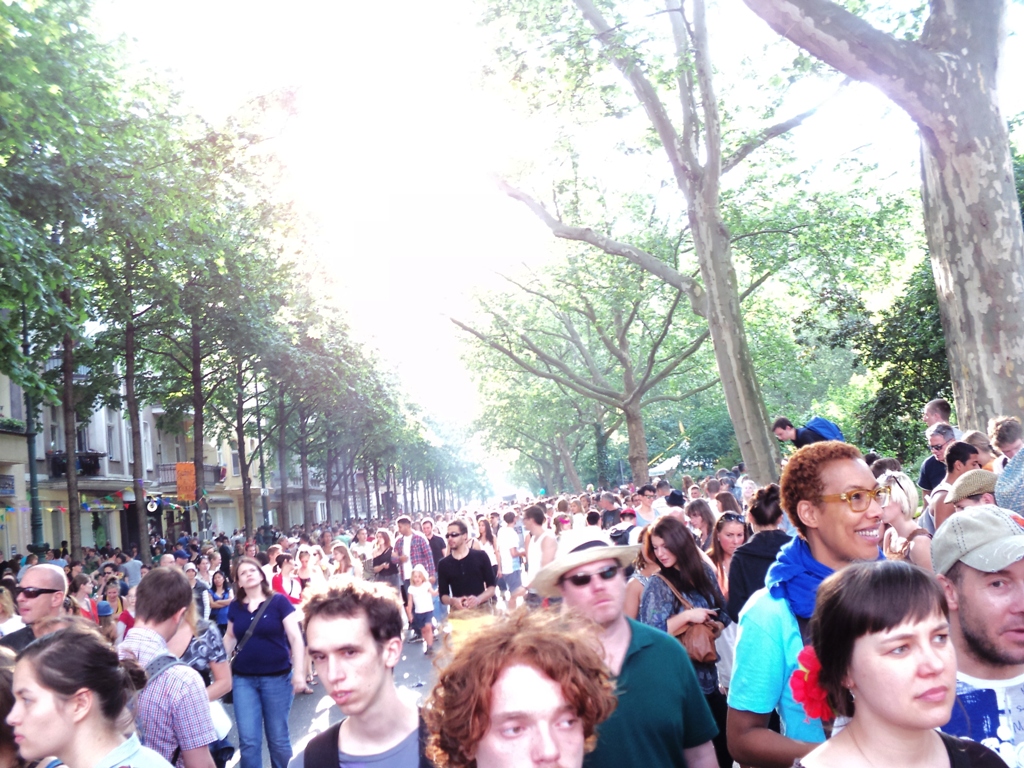
We looked around, and then we saw a deluge of people who were walking, running and eating. He was true; the venue was widening in each second. It was like an oversized train and each group of people became a chain as in such a train in which each compartment becomes its part. We walked forward and followed the people. We knew at least one million people would turn out there on that Sunday. After a stride we stood for having a slice of bread and ya, again walked forward. We looked as if three chicks which walk at a moon-lit night. We could not know what exactly happening there and we were wondering that it was the much celebrated carnival of culture! After walking at least 3 KM, we reached a place where lakhs of people gathered massively and we saw countless counters of eateries. The first one at the extreme corner of the road was a Tamil restaurant run by Sri Lankans, we just waved our hands. There were hotels and stalls of each countries and they served very diverge tastes. From that time, the crowd was getting increased in each moment, the place suddenly suffocated with the excess of the throng. We thought we would miss each other in the crowd.

Suddenly we noticed in the nearby street road, five-six police vehicles were moving bit by bit. We were afraid of something bad which was about to happen. We crossed the road and expecting that ‘something’. When reached there we felt the street was already parted very nicely into a beautiful path and from afar a saffron coloured flag was seen. We read it No. 1 and at a snail's pace, it was coming out from the western side of the street. We made our camera ready to catch the moment. A relentless and continues music was approaching towards us. When it was about to reach at us, we knew it was not one, a flood of parades were coming there. The sounds of the different music rested above. Yes, the riot of colours here started! 

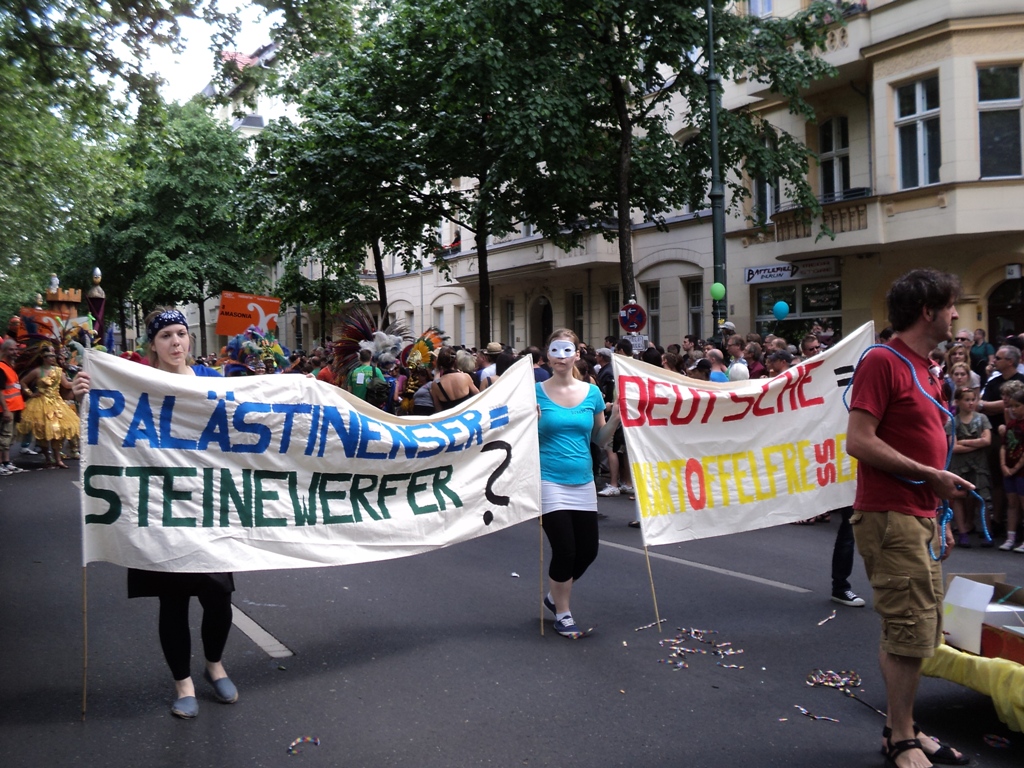
The great parades of Carnival of Cultures have just begun. People lined up with their innovative ideas and dresses. Some people came there with wonderful and strange dress, some with a minimal dress and some with full covered dress. We saw Palestine people with a placard declaring their solidarity to the Berlin Festival. Children from different parts dressed up beautifully and sang fantastically, and then they were seemed as fresh angels flied down to the earth. Some played tricks also. Small kids mixed their hands with chocolate and shook hand to people only to make others hands dirty! A funny chocolate shake hand! When Vivek saw a kid offered a hand, he shook his to get a fistful of chocolate colour! He could not understand what was happening and the lady near to him very politely offered a tissue paper to clean it. Yes, it was the time to celebrate, dance, make fun and also such a simple help.

On the Sunday of 27th May 2012, about 4.800 participants machinated in 90 groups changed Kreuzberg District of Germany into a riot of colours and ideas.
Every summer, Berlin celebrates its own unique carnival, called the Carnival of Cultures - more than 1,5 million visitors flock to the district of Kreuzberg to celebrate the multicultural spirit of Germany’s capital. The procession started at 12.30 pm, at Hermannplatz and ended approximately 9.30 pm, Yorckstraße.
The street procession focuses on the cultural richness of Berlin, and also highlights the often hidden treasures of its international cultural scene. It questions everyday life and politics. Carnival is a combined art form that embraces many aspects of artistic expression. Due to the global migration currents it is multifaceted and of mixed styles. 

The Carnival of Cultures is open to everybody and all forms of cultural expression. It is regarded as a platform for a proud expression of hybrid cultural identities, containing traditional and contemporary elements. It includes and attracts all age groups, professional artists and amateurs, people from all walks of life. People from all over the world come to Berlin to take a look at the colorful costumes and cheerful performances. The carnival of Cultures is one of the main events in Berlin which is taking place every year through the streets of the city between May 25th and May 28th in 2012, with a four-day street-festival, the Parade (28th of May) and various parties throughout the whole city.

The colorful highlight of the festivities is the street parade, where more than 4,500 performers in authentic costumes, elaborately decorated floats, and musicians from over 70 different countries dance through the streets of Berlin. 
Soak up the samba rhythms, enjoy Brazilian drummers, Congolese singers, Korean culture groups, artistic larger than life puppets - and a bit of Rio de Janeiro in the streets of the German capital.
The idea of a carnival which presents the cultural and ethnic diversity of Berlin was developed in 1995, i.e. at a time when – as a consequence to the political and economic changes since the fall of the Berlin Wall and the unification of the two German states – a lot of social, economic and cultural changes happened. Due to these changes, to the economic decline of Berlin and the different economic levels and social and cultural experiences of people in East and West Berlin, social conflicts became more evident and even increased. This state of change resulted, among other things, in a biased and prejudiced view on immigration, which was reflected in the public discussion.

At the same period of time, Berlin attracted a growing number of artists from all over the world and a new cultural off-scene developed, which added to the cultural richness of Berlin. Berlin developed into one of Europe's music centres with a focus on different styles of electronically generated music.
There had been attempts to initiate a carnival in Berlin in the past. Those concepts which had been based on already existing patterns, like the carnival in Rio or the Notting Hill Carnival in London, did not gain sufficient support and could not be implemented in Berlin.

The involvment in carnival activities strengthens the bonds within ethnic communities and among all the groups alike. Their presence in the national and international media lead to a growing self-esteem within ethnic communities. Therefore, the Carnival of Cultures promotes the awareness for the positive impact made by immigrants on Berlin's cultural and social life. Large numbers of young people are involved in carnival activities, many of them coming from multi-ethnic or difficult social and economic backgrounds. While participating in the preparation for the carnival, many of them develop a level of commitment and reliability most unusual in their daily life. Many bands from Berlin's wide-ranging live and electronic music scene as well as theatre and art groups add their aesthetic visions to this sensual and joyful celebration.

Berlins Carnival has been inspired by modern European carnivals like the Notting Hill Carnival in London and the Rotterdam Zomercarnaval. It has taken in elements of many traditional carnivals and celebrations from all over the world. By being open to cultural rites, customs and traditions it attracts performers from countries without carnival traditions. The inclusion of all these elements makes the Carnival of Cultures in Berlin quite unique.
By inviting numerous associations, institutions and individuals in Berlin – among them theatres and arts schools, youth and community clubs and ethnic associations, individual artists, musicians, bands and DJs – the WdK built a network of carnival activists which was and still is the basis for the Carnival of Cultures.

From the beginning on, it encouraged a discussion on the adaption of elements immanent to carnival, including music, dance, masks, theatrical elements, performance and crafts.
The WdK provides the participants with workshop facilities for the preparation of costumes, masks and decorative elements for the floats. By doing so, it offers the groups a chance to meet and discuss their artistic concepts and means of implementation. The artistic quality of the group presentations has been stimulated and increased by the introduction of a competition during the parade in the fourth carnival year, 1999. Prizes are awarded to the best carnival groups, floats and youth groups thereby encouraging the development of all aspects of carnival.


We were watching each country and each and every country dressed up magnanimously, China came with a giant dragon, Japan appeared with a wonderful melody playing, all most all European countries came with an adorning festivity. We three waiting for India, we were sure, India would come if not now but definitely by late. For example if you visit the East Side Gallery painted in the (in)famous Berlin wall,  the last painting  is the Indian flag with a description of Amma Amirt, Budha nirvana, Muhammed light.... an Indian painter portrayed the glory of India in a very artistic manner. What I am saying here is India is near to the heart of the people of Berlin. So we waited and waited. When we felt hungry we went to a Turkish Kebab shop and ordered falaphel but with opening our one eye to see Indian parade.

Then we heard a Bengali song and a group of Bengali babus. We thought it would be India, but they were the exact Bengalis, I mean the people from Bangladesh. They stepped with the dance they were playing. People were expressing their ideas in a very attractive manner. We saw the protest against the non-vegetarian culture by the proponents of the vegetarian culture with a huge pig shedding tear. We saw the German parade who were shouting against the privatization and chanted for swedeshi brand. After a pause, there came Nepal with a very impressive theme. In the front of the rally, people dressed up like the three important religious priest. A Hindu sanyasi, a Muslim moulana and Christian achan and the people same dressed in the same manner followed them. It upheld the harmonious character for their country. They shared words in Hindi.

Parades came and went, we saw a lot of countries flags except India, but when it seemed the parade was ended, the next rally started. We were optimistic and walked towards the origin of the parade and thought when Indian parade started we could also participate in it. It was near about 9 O’clock at night. When we were about to reach the venue we saw a mixing of light in the sky and deafening sounds, and thousands of followers started to line up in a parade at the starting point. It was the African beauty. People were mesmerized with the charm of African wild music as a flout man’s pipe and followed them. It was amazing. We stood still and waited again for India. And the last parade came again a Latin American parade. Even the last man followed it. 

That moment we realized India would not make its usual last appearance. We were desperate. Far away we saw some ladies with ‘Indian sarees. They must have also expected an Indian flag in this all cultures event. We approached them and within moment made a new plan. Immediately we drew an Indian flag and upheld it and walked forward as we were representing India.
Saare jahaam se se achaa
Hindusthan Hamaaraa..
Sang we loudly.