Tuesday, January 8, 2013

Book Review: In those days there was no coffee Writing in Cultural History by A.R Venkatachalapthy


 ‘History is not yet what it aught to be’ – Marc Bloch


This book narrates the day to day life of Tamil Nadu in colonial time and their cultural artifacts in those days. AR Venkatachalapathy explains how coffee, tea, tobacco and other cultural signs had significant meanings in the colonial time. Instead of going to the stereotypical, elite and traditional historical narratives, Venkitachalapathy, a disciple of KN Panikkar, searches what roles coffee, tea and tobacco engaged in the making of modern Tamil Nadu. The book is divided in two parts and in the first part both material (coffee, tea and tobacco) and cultural (the cartoon, the city and modern literature) artefacts are elucidated and further the books related how they were consumed in colonial Tamil Nadu. And in the second part, it engages with the politics of language and identity in colonial Tamil Nadu. In the first part, the discussion is about the coffee. Coffee is not a simple word in those days. It is something very important sign, a cultural symbol which differentiates a range of cultures which transform through various trajectories. Drinking coffee was considered as a habit of middle class/ upper class/ caste of Tamil Nadu. Coffee has been accepted in the cultural domain of Tamil Nadu after years’ long negotiations with the tradition and practices. It was also considered as the symbol of acceptance of modernity of Tamil Brahmins and the reluctance of lower class/ caste people. It is not as easy as saying ‘drinking coffee’ but some opine that ‘One can write a whole puranam on coffee’; and ‘to go without my morning cup of coffee is like the world as crucial economic crises.

The story of coffee is a very recent one. According to the archives, the morning cup of coffee was unknown to people in those days. Coffee was first cultivated in Ethiopia; but soon it reached in India with it’s its cultural other, tea. But when it was introduced in India, it represented the colonial Europe; soon the debate was centred on the replacing of morning drink –neerajaram- of Indians with an alien drink -coffee-. So the general opinion was that coffee drinking is not required in our nation. Our ancestors never ever consumed it. Coffee is a kind of liquor. Stri Dharma, a radical woman organisation claims: ‘coffee here seems to stimulate cheerful for a little while  after drinking, but gradually subvert the vitality of the digestive organs that’s why the body is weak, this creates all sort of unknown diseases. People in Tamil Nadu used to drink the cold rice in those days, but coffee created a threat to that habit. So the debate soon diverted to the English coffee Vs Indian cold rice (payachoru) and cold rice personifies coffee as an immoral woman, who has led people astray and disturbed the (fasting) austerities connected with amavasi, ekadasi and karthigai. The patriarchal way of life taught that women are addicted coffee and consumed to western culture.

But the upper caste Brahmin used coffee as an evidence of their earlier acceptance of colonial modernity and they utilized it to dominate others, soon Tamil Nadu faced the discrimination in drinking coffee. For cultural reasons both coffee and tea were understood as the specific symbols of upper and lower castes. For Brahmins, coffee was a touchstone of hospitality, even if they were not providing coffee to their hosts, a mere invitation would do more in that days, the question ‘let’s have some coffee, was more symbolic than the act of providing coffee. If they did not invite for a coffee, it was understood as an insult to the host. The most insulting word in those days was to say, ‘their coffee is awful’. When coffee was a cultural symbol and more coffee hotels were open, Brahmin of Tamil Nadu found a new method to keep their notion of pollution up. They introduced the metal tumbler with rims. It served the role of hospitality to their co-casters and also a tool to keep untouchability. 

When coffee was somehow accepted in day to day life of Tamilans, the Tamil literature started to reflect the new habit. A lot of short stories, articles, puzzles, and riddles were written on coffee. There was an interesting passage in Tamil short story in which Siva descended and offered Kandasami Pillai a cup of coffee with Him. The story goes on like that:

‘As god sipped the coffee, a divine demeanour of having drunk some suffered his face.
This is my leela, said god.
‘This is not your leela, but the hoteliers’. Mixing Chicory with coffee is his handiwork. Show your mettle when you pay for the bill’, whispered Kandaswami Pillai, with his ears, content that he had sorted out the issue of paying for the coffee.
Chicory... what’s that? God looked up quizzingly.
Chicory powder resembles coffee, but it is not coffee. Like those who defraud people in the name of god’, replied Kandasami Pillai.

The issue of good/bad coffee rose soon. Making coffee with buffalo milk was a sign of cultural and moral degradation. It countered with the ‘Pasumpal Kapi Klub’ of Brahmin and Beef biriyani of lower caste/ middle class people. The Coffee hotel which was started every nook and corner of Brahmin populated streets soon became specific cultural symbols. Every third house is either a hair dressing saloon or a coffee hotel. This coffee hotel played the role of a place of congregation, for traders to clinch dealings with others, for families a meeting point in week days. The general addressing of coffee maker was, ‘Iyer, bring me a cup of coffee’ which says, that only the upper caste Brahmin had run hotel in those days. To overcome caste pollution, each hotel facilitated separate corner for Brahmins, and to question this was interpreted as the interfering of the personal matters. Later Periyar Ramaswami sharpene3d his knife against this inhuman practice and called for forcefully destroying the board which showed a sign of Brahmin.

Tea acted as the other of coffee. It was considered as the drink of middle class, lower caste people. The advertisements of tea have always been shown with the working class people. All most all the offices served with tea. Unlike coffee which was served mainly in Brahmin’s coffee hotel, Muslims were famous for strong and best tea. The common notion about the best tea was, ‘the best tea can be had only at Muslim house hold and non- vegetarian restaurant run often by Muslims. In colonial Tamil Nadu, both coffee and tea understood in a very different ways. Both produced and reproduced very different connotations, meaning. Though reluctant at first when coffee was introduced, but later it became a habit of most of Tamilians, there is story in Tamil literature, and it can be read as:
When a husband and wife quarrelled each other, wisdom appears and advises them that,
‘I tell you seriously, and after bitter experience, whatever you do, don’t cut out coffee. You may cut out food, you may go out in rages, or walk three miles to your office, but don’t meddle with coffee.

The story of tobacco was very different from that of coffee and tea. Tobacco was readily accepted by Indians. But later, after the colonial medicine and education introduced in India, tobacco lost its earlier charm and was considered as an intoxicants and dangerous substance as ganja and other drugs. If lend the words of Ashis Nandi, Tobacco was an Indian crop accidently discovered by the European! It was in its earlier days considered as a sign of good life, relaxation, cultural attainment and so on. Without any resistance, the Indian farmers accepted it as a domestic crop. It was not for exportation for two reasons. Europeans considered the Indian tobacco as coarse, rank, ill-flavoured. And Indians felt all these accusation as positive and they liked it, so the exportation held in a very low rate. 
The Tamil word for Tobacco is Pugai-ilai which means smoking leaf. Soon tobacco was explained with divinity. Divine origin of tobacco as explained in Tamil literature is: once three gods Siva, Vishnu and Brahman had a quarrel each other over the supreme power. Each claimed they were the most powerful. To find out a solution it was suggested that let three of them keep a leaf with them and give it without losing. Siva was given a vilvam leaf and Vishnu a basil leaf and Brahma was given a tobacco leaf. Both Siva and Vishnu lost their leaves, but Brahma could keep his leaf with him, and he relaxed: ‘em pathram pogalai’ (my leaf is not lost), the tobacco got that name, pogalai from this word. The rest of the book deals with other cultural and literary issues like cartoons in colonial Tamil Nadu, Imagination of a city, literature, culture and Identity.

Tamil Nadu from time immemorial tried to stand alone and agitated the cultural domination of non-Dravidian forces. So it stood up against the imported Indian nationalism over Tamil nationalism. Whenever a call for English/ Hindi/ Sanskrit education, then they counter-argued for a Tamil Nationalism.  Non Brahmin Vellalar elite challenged the notions of a monolithic Sanskrit based Hindu vision of India. Jadunath Sarkar’s book, ‘Confession of a History Teacher’ deals the importance of English in history writing. To him, for a better history work, English (language) is a necessary thing, a historian without linguistics skill and literary abilities and sensibilities would be no historian at all. According to Partha Chatterjee, all the historical works written in colonial time expressed the duality of material/ spiritual, outer/ inner, man/ women, world / home. The book seeks to negotiate the hierarchy of knowledge. Literature aspiration to occupy the space between the best of professional social science writing in English and the culturally sensitising centre in Tamil Nadu addressing for the most part of literary audience.

Thursday, January 3, 2013

Trace: A Strong Messege to the society

“I read about eight newspapers in a day. When I'm in a town with only one newspaper, I read it eight times.” - -Will Rogers


The assassination of T.P Rama Chandran has wounded the psyche of Kerala profoundly. Kerala has already eyewitnessed a number of political murders, but the killing of TP Rama Chnadran must be read in a diverse angle. More over a conflict between two different ideologies, TP’s murder actually tells us the bigotry of a mainstream political party to its faction which was formed in very particular political circumstances. The people of Kerala have carried the burden of the incident of the assassination for a long and they woke up anticipating an odious event each day. The people were frightened of someone who was honing a knife for him/her. 

(to watch the film on youtube kindly click here)


                                     (The film: Trace)


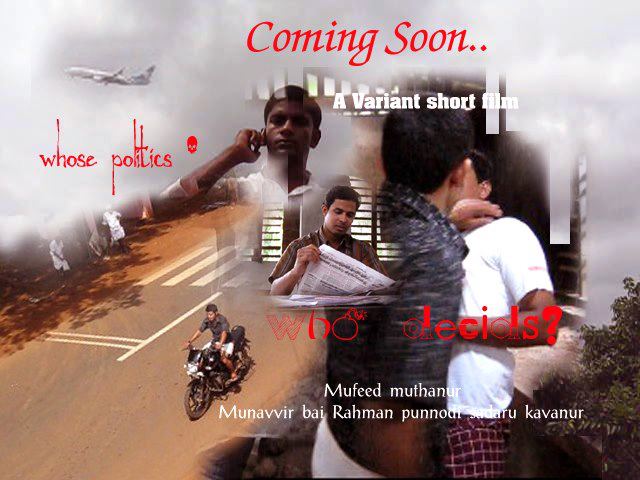
The sequence in which TP was viciously killed with more than fifty stabs in his body has made a strong ripple in the society. Even the cultural leaders who were believed the bed-shares of Communist party broke their silence against this brute killing. The young film director Mufeed Muthanoor has developed his new short film ‘TRACE’ from this point.  Each murder is a very well planned one. When the foes set off for killing a targeted person, the plan which is already conceived gets practiced. We are afraid even the single word, ‘murdering’ ‘killing’, because the word itself generates complicated and many-sided meanings which injure the psyche of the society. A murder is very perilous and dodgy to the cultural paradigm of the society and it needs a lot of time to heal the society from the blow of such an incident.  How the repeated political killings trim the society down into permanent panic condition, is the starting point of this film.

Ayyappa Panikkar
Ayyappa Panikkar, a Malayalam poet, might be the first writer who analysed the process of meaning-making of a trouble-free word like ‘murder’. In the word ‘Kolapaathakam’ (murder), even it’s each letter can produce different connotation. It seems at the first look, that these separated letters and syllables of ‘kolapaathakam’ are very innocent, above suspicion and without any meaning, but the tone of each words actually manufactures some meaningful symbols, Ayyappa Panikkar observes in his poem, Kolapaathkam’.

The media which push the boat out each news on political killing by manoeuvring, colouring and embellishing, are not actually aware about the injuries they are causing to the minds of the people. This news on killing are actually affecting to the young people of any society. 

Mufeed starts the film, Trace in the milieu of a newspapers reading room.  The everyday readings of the newspaper, according to Charse Baudelaire, actually negatively affect to the people. He says, ‘any newspaper, from the first line to the last, is nothing but a web of horrors, I cannot understand how an innocent hand can touch a newspaper without convulsing in disgust’. It is right in a sense, if we analyse how different media establishments handle the news items such as killing, rape and others which damage the positive attitudes of the society, then we can understand the intensity and depth, these news cause to the society. Each reader internalizes what he/she gets from the newspapers and he/she develops the same view point whenever gets a possibility to harangue about the incident. 


Mufeed Muthanur (Director)
After visualizing the manner of how different media handled the news of the heinous killing of TP, the director portrays some youngsters who have internalized the reporting of their own politically biased newspapers look the issue in different angles. The story starts when the reading room which is supposed to be a platform for creative discussion, turns to the political debates and discussion, then a silent reader sitting beside them, starts off his bike and rides it very swiftly. 

The background music and the political symbols which are repeatedly shown in the film produce a feeling of dread and insecurity in the viewers’ minds. The quickening bike, knife, the broken words from mobile phones, airport and others intensify the terror in the viewers. After repeatedly shown all these panic-producing symbols and the bike ride which terminates in a very isolated house. The film ends when the protagonist after a high drama and long-time-suspense slashes a water melon. 


Punnodi MA Rahman
Political killings, as any other crimes should be punished strictly. And in some cases the assassin may be punished, but the injuries and pains a society suffers from such killings are seldom healed. This is the message of the film. The body language of such murdering is in a conspiracy, this clandestine nature of such action, in fact making even a daft job like cutting a fruit in suspect. The basic function of a knife is to use for cutting vegetable and fruits, but even such acts are made in doubt in the changed and charged atmosphere. All the characters are youths in the film. Even the youths who are thought to be very audacious and courageous are actually living in the fog of trepidation, and then pondering over the mental trauma of weaker section of the society is more panic.


This is the third project made by KPB Production. MA Rahman Punnodi performs the leading role. K.P Sadarudheen, Munavvir Alingachaal, Suresh and Muhsin are the other actors of the film.


Thursday, November 8, 2012

Book Review: Giving Offence by Martin Rowson


After a long, exactly after 2 months, I am lettering another blog post! Frankly, a minute before writing this, I have never thought I must write something. The sudden reason for this new blog is, what I encountered in EFL library today. We had a presentation today, so as always, I went to participate it before an hour, and I had an hour to spend in some way. I could have gone to the teashop to meet any of my friends, or to open facebook and upload a new photo on its wall, or to sleep and see a wonderful daydream, but I preferred to be a good boy, therefore, I went to the library. I had an empty bag and the bag was not allowed to take inside of the library. An empty bag always behaves like our intimate friend and some theoreticians already introduced the importance of the possessiveness of a bag. For example, in everyday he is talking about the possessing of a bag and why a bag is important.
I got a token, and when I was about to sign the registrar, suddenly the security person asked my ID card! The interesting thing is, that security guy knows me well, he sees that I come and go back from the library at least two-three times every day. Still he dared to ask me the library card! I avoided his demand and pretended I heard something else, but he repeatedly demanded and glued on his need. I felt strongly offended by that person and in a hurry; I took my ID card and rushed inside the library. To air out my felt offensiveness, I could go out taking my bag arguing with the security guy or simply go and sit before a book. Here again I preferred to be a good boy. Therefore, the next option was to select a book that is suitable to the situation. Here I, either, could select a book on Mappilas of Malabar (I know there are two books in the library), or go to the magazine section and read something. In that moment, Martin Rowson’s book appeared to console me!

In the new arrival section, I saw ‘Giving Offence’ written by Rowson, a London based cartoonist. His self-explanation is one who gives offences to the society. This book is examining the psychic of an offender and why people always are offended by others. Offence, like beauty, is in the eye of the beholder and it is a subjective business. There are many minor offences, but there are also some major offences that are not worth to be mentioned like cannibalism, incest, paedophilia, necrophilia or coprophagus. He traces the history and goes for saying that these overwhelmingly offensive acts were practiced somewhere in some point of time. For example, Tom Stoppaardi’s noted-play Jumpers explains the cannibalistic practices of some society. The playwright describes a community who eat their parents’ dead bodies believing that by doing this they are actually venerating their parents. Even Christianity in certain community played a role to encourage them to eat the brain of the dead bodies. For example, a new disease, Kuru was found among Fore People of Papua. The reason for this disease was when they converted to Christianity, they mixed their own ritual practices with the new theology and started to ete their parents’ brain when parents were dead.
Incest was a common practice of most of the ancient communities like Greek, Roman, Egyptian and ottoman to protect their monarchy and to revolve their power around their own people. Paedophilia is seen in some societies still. There is a myth of Zappa about his act before a huge crowd. Once when he was performing in a stage he challenged the audience to do the most repulsively offensive thing they could imagine, he promised to outdo that. A woman did a ‘most offensive thing’ and he, as promised, outdid that.

Offence is a very subjective one, a daughter is easily offended when she is not allowed to wear what she wants to wear, a father is offended when he sees his son wears something he does not like, and the daughter is offended when mother wear an old dress or something. There is a story about a German Brownshirt. She went to watch Marx brother’s movie. She liked it and she laughed, laughed and laughed. But when she came out, she knew that Marx brother were actually Jew, so she was offended and went to the counter demanding her money back! Humour can be used both aggressively and defensively. When Diana was killed in a car mishap, it actually made mixed responses. As a satirical cartoonist, our author drew some cartoon on Diana’s death and it invited the offence of some people.

He goes to explain the caricature and how caricature works in a society. When 9/11 happened, he drew a cloud sky, called his manager, and said to him that he had a meaningless and senseless cartoon. The manager was impressed and responded, ‘this is the best time to give people that meaningless and senselessness!’ The book is written with very less pages and in am easy way to comprehend the idea he is presenting. I read it and ran to participate the research scholars’ open presentation. 

Monday, September 24, 2012

Staying a Night at Nagpur Railway Station! An Incredible Journey of a mother 2


It is the second part of the travelogue of a journey I accompanied with my son to Delhi via Hyderabad via Mysore. In the first part (kindly click here to read the first part: (An Incredible Journey of a Mother to the Heart of India), I was telling what happened to the ticket and why we booked the ticket first to Nagpur. When the train paused in Nagpur, the sun had already sunk in the Arabian Sea. The strange and fearful atmosphere stared at me. I could not realize anything, everywhere an alien language script laughed at me, strange people gazed and the whole railway system threatened me. My son was in a deep silent but he was pretending that a smile was there on his face always. I got down in to the platform with praising Allah. We travelled the half way to Delhi.

Nagpur, a land of Orange! The story of Nagpur also related to Delhi, Delhi sultanate and of course, Hyderabad Nizams.  Bhakt Buland initiated Nagpur city after he visited Delhi in the early 18th century and declared it as his capital. He was the Gond prince of the kingdom of Deogad in the Chhindwara district.  His successor Chand Sultan continued the work. As happened everywhere after the Chand Sultan in 1739, the princes fought each other for the throne and Raghuji Bhonsle, the Maratha governor of Berar, helped to restore the elder son to the throne. Raghuji Bhonsle camped there and intervened in 1743, and the control of Nagpur slowly passed on from the Gonds to the Marathas. 

It became the capital of the Bhonsles. With the Bhonsle dynasty came the vast class of cultivators in Vidarbha. Raghuji's successors lost some territories to the Peshwas of Pune and the Nizam of Hyderabad. In 1803, Bhonsles (along with their allies Scindias [Shinde] of Gwalior) at Assaye and Argaon (Argaum). In 1811 Pindaris attacked Nagpur. Bhonsles again lost to the British in 1817 and Nagpur came under British influence. In 1853 Raghuji III died without an heir to his kingdom. As a result, the city lapsed into British control under Lord Dalhousie's Doctrine of Lapse. In 1861, Nagpur became the capital of the Central Provinces. The advent of the Great Indian Peninsula Railway (GIP) in 1867 spurred its development as a trade centre. After Indian independence, Nagpur became the capital of Madhya Bharat state (C.P. and Berar). In 1960, the marathi majority Vidarbha region was merged with the new state of Maharashtra and Nagpur was designated the second capital of Maharashtra state, alternating with Bombay as the seat of the Maharashtra state legislature.

However, my mind was troubling with the image of Nagpur I was getting from the newspaper reports that it is the head office of some extremist organizations. I was compelled to stay there a night! I did not know where my hotel room was booked. When I asked the room, his smiling turned a big laugh and it took two minutes to slow down, when he finished laughing, in a very low voice, he said, ‘we are luck, today we booked a huge room  with 24 hours electricity’. Therefore, I was happy, but scared, if I stayed that big room, the amount must be very high. . After few minutes, he turned me again and said,

‘Mom! Don’t be worry if say anything’

No. Not at all.

‘That huge room I booked is here, with these people!’
He pointed to the sleeper class waiting room.
The room was clean, the cleanest place I have ever seen. However, a huge number of people have already booked each place in that ‘huge room’ with 24-hour electricity.  A man was sitting before the room with a register to check whether we were upper class ticket owners. Moreover, outside of the room, there were flood of people staying here and there.

‘Now, we need to keep our luggage in the clock room’, saying this, he went in searching of a clock room.  The security was very strict, they checked the luggage carefully and gave us token and we kept the luggage in the clock room. When the heavy luggage from our shoulder removed, we felt very relieved without any burden.  ‘Now we can have something for dinner’.  We went outside. There the crowd was moving aimlessly as if they were paral fish in a stream. Everywhere people packed largely. I was thinking about myself, ‘A woman who came from a faraway place, here in a very strange place with her tongue tightened and feet trembling. Her only proof to believe she is in a Hindi speaking belt was her hand grabbing her son’s hand’! That thought tightened my hold his hand further. When he felt it, he turned and asked,
What happened?
Nothing’ I was thinking a story I learnt in school in my fourth standard about four poor animal friends’
‘Which story?’
‘Four animals, a cow, a mouse, a deer and tortoise, they were good friends, but all were very much dependents each other, they did not want to miss anybody, and being helpless and small animals they were scared about everything’
‘I know that story but why you think the story this time?’
‘Missing is painful’
‘Don’t worry, mom!, you know there are millions of people live in our India, and we are just two drops in this great ocean, I will stay with you always, and there is no question of missing. Hey mom, he is selling oranges, so we can have some oranges from him’

We did not think about the price of orange, because there is saying that if you want to eat apple from Kashmir, do not go to the shop but go to an apple tree and collect scattered apples underneath the tree. 
We went and asked that man the price of orange, the price was double of what I usually got from any shop in Kondotty! ‘What a world!’
We saw a restaurant there. When I saw the menu, I whispered in his ears,
‘Choru kittumo?, (Can I have rice?)
However, my sound was little high, then all people seemed to stare at me, I was afraid and looked at my son’s face.
He smiled and explained me.
Mom! You know we are far far away from our land, nothing will help us now here, our culture, food, language, dress, bed, house, nothing’

I agreed, ya, my dress has changed, look! I have never worn a churidaar for past many many years in my life, but now my dress is churidaar, my Malayalam, my house, everything I had given up in Kerala!
‘Therefore, when we were what we were not, then all our meaningful words will produce some other meaningful words’
He looked as if a philosophy teacher and I could not understand his words.
‘You know the word; choru in Hindi means thief, that’s why the hotel cashier looked at us! You might know the story of two Malyalees who went to a hotel in Delhi’
‘No, I don’t know’

Once Two Malayalees went to Delhi to participate in a party conference. When they were hungry, they went to a restaurant as we did now. They ordered two plates of poratta, and they did not get curry for sometimes, so one of the person shouted, chaar (curry in Malayalam), then the next moment, the waiter brought him four poratta, when seeing this, the other guy signed and said loudly, ‘che!’ (a sighing sound). The waiter again came with six poratta, when they got six more poratta, one friend, lost his temper and clamoured to the other friend, ‘Kazhutha! ivianeyokke ivideunnu aaattanam’  (Donkey! He should be ousted out from here) this time, with their surprise the waiter came with eight poratta! Again the other Malayalee was about to say something, then the other guy, pressed his mouth with his full force and said, don’t say anything, if you say any word, the waiter will bring you more and more poratta..’

I enjoyed that joke and kept in silent. He ordered something, and then I realized I was losing even my rice for at least two weeks.  The food was nice and tasty. Night was darkening more and more, and I saw more people were coming to get a space in each corner of the street, we walked back to the station, station was packed with the people, and anyhow I got a seat to sit there. Everywhere people spread their cloths and started to sleep. he asked me what I usually pray before going to sleep, I briefed up the prayers I usually do before going to the sleep, then he said to add one more thing to the prayer,
‘What?’
‘To not come TTR or checker to the station’
‘But, why we already have the tickets?
‘We have the ticket, but we are not allowed to enter the platform before four hours of the journey, our journey starts at 9.30 tomorrow morning!’, 

he continued, but don’t worry, our journey is not any ordinary trip, we are going to know the pulse of India, so everything should be welcomed in the journey. Each event will be an added experience in our journey. This journey is not for any destination, but it it’s destination is wherever we are led’
I looked at the people, they are very happy, and everybody has dreams, hopes, happy, so I also should be part of the sleeping mass beside me’ when a lot of thoughts flooded in mind, sleep visited my eyes gradually.

(English translation of a travelogue written by Maimoona Rahman KP )

Thursday, September 20, 2012

In Memory of ‘the Brightest Night of the Year’


Now I am writing about the brightest night of the year (der Klügsten Nacht des Jahres), which is a whole night devoted for science and, of course, for arts in Berlin and Potsdam. The programme begins late at night and goes without ending until dawn! That day different universities and institutes come together to show what miracles they have in their hands. For the twelfth time scientific institutions in Berlin and Potsdam together organized the "Brightest Night of the Year", in which a total of 73 universities, colleges, research institutes and technology-oriented companies opened its doors in June 2012. The comprehensive program included an almost endless range of topics. There were also events for urban development, economy, social issues and much more. Embarked on a journey of discovery through the scientific community, where one could experience firsthand what being researched in these two regions.

Small researchers had in the numerous activities for kids get a first impression. This year's theme of the night of science was, a "fireworks in the brain." This was an incentive program and at the same time, this year's Long Night offered a firework of ideas and knowledge, and we enjoyed the "brightest night of the year." The idea was wonderful!

A full day to celebrate! A celebration which directly pierces to our brain and mind. The first day we reached the university, Prof. Dirk Wiemann asked us to participate in a seminar presentation he would do in this day. The topic was interesting; it was about the Indian graphic novels. I have not read any graphic novel before, but ya, definitely I did read all most all amarchitrakatha published in Malayalam.

It was a very cold day; even our bones broke with the chilling climate!  I could opt to either wear my usual red coloured sweater or wear a blue coloured t-shirt and show the people our team jersey. Actually, the t-shirt and the badge were two marks to recognize us when we were in the presentation room. 
We went to Golm campus early morning, and we saw there were a long queue and a ticket counter. When we knew, the ticket price was 13 euro (Rs.910!) we thought to drop the plan to go in and we  decided to participate in the seminar in which we were a part. We went to the gate to ask about the programme, and we saw a very few students wore the same blue coloured t-shirts and badges. Moreover, they smiled at us. The security before the gate greeted us. We were thinking some magic of the shirt. We went to a door, where a blue coloured t-shirt dressed woman kept just before it to check the ticket. We pretended to ask something, but she smiled and greeted us. We entered the hall. Then we realized the badge was an entry ticket which permitted us to see the entire programme.

The first door led us to a chemistry experiment hall.  People thought we were science students; they were creating different substances and making experiments. I suddenly remembered my Pre-Degree Classroom. I was scared all the acids and experiments. (That is why I ended up in an art subject for my Degree!) For my final exam, there was a question to recognize some acids; I think, it was phenyl acid. The only thing I knew about that acid was that phenyl burns our skin. Therefore, instead of making any experiment, I poured two drops of phenyl into my palm using a scale, nothing happened, so I confirmed that it was carbohydrate or some other stuff, and started to answer it. I completely forgot the scale, which I used to take the acid. When my exam passed the first hour, accidently I put my hand on the scale, I heard a shii sound and smelled a burning skin. My left hand made a black mark of burning acid, the neighbouring girl was shocked, and she was about to faint but I winked at her and said, it is ok, I got seven marks freely, I corrected the answer and thanked the phenol for giving me a mark on my left hand a 7 marks in my paper.

When the research scholars realized we were not science students, they said that all were for children, and there were already a bunch of school-going children surrounded them.

‘Could we participate in your experiments? Vivek asked them.
‘We are sorry; it is only for school going children’
‘Oho! But we are university-going children!’
‘Ok, then you are welcome’.
First was a DNA forming experiment from a banana. One should come forward to help the researcher to do the experiment. I was thinking all the experiments I did my Pre Degree and took two steps back. So Aparna went for it. The guy explained us how a DNA is formed from banana. He said to do different processes. To our wonder, we got a DNA in a test tube. Oho, the term test tube also forced me to remember my PDC chemistry lab, once in the lab, with my hand, I broke the tip of a pipette (burette?), that day  just got over.  However, when I went there to get my transfer certificate I got a due certificate of breaking the tip of the pipette, it was some 350 rupees!)

After the experiment, they presented that DNA as a gift  for completing the job successfully. Next was an experiment to create thermo-coal-balls. This time Vivek was ready to be the scientists, it seemed he also was thinking his +2 science class. It took too much time to complete the process. At last, he also got the gift. The least dangerous experiments were blowing a balloon with ice. This ice was very different. It became the evaporated stage directly from ice without a liquid stage! They filled the balloon with this ice, and the balloon, then started to puff with air. That was amazing. I got that balloon as a gift! We came out from the chemistry laboratory. 
Then it was the time of music. We heard a very beautiful music from the courtyard of the Golm campus.
Our presentation time was around 10 pm at night. We were asked to read four graphic novels, these were:

Delhi Calm by Vishwajyothi Ghosh. This is a picturesque description of what happened in Delhi (India) during Emergency. It explains the whole issue through a journalist’s eye. I am sure it will please those who witnessed the sleepless nights of Emergency and those who know the short cut routs of Delhi.


Tinker. Solder. Tap by Bhagwati Prasad and Amitab Kumar. It is a very sataristic story of how piracy is well worked in India. The transformation of film piracy through Cassettes to DVD is simply described in the book. Again, it explains the India’s big piracy market, Palika Bazar. As the authors know that, any of the creative products is not free from piracy in India in this globalized time, so they have given the permission to ‘pirate’ the book. It is available in this website, www. sarai.net. In the cover page, the authors have written: ‘Any part of this book maybe reproduced in any form without the prior written permission of the publishers for educational and non-commercial use’.
 
Indian by Choice by Amit Dasgupta. This is specially written for NRI citizen who live in hi-fi metro cities. It is a journey of a Punjabi rooted Manddep Singh who thinks India as a very unproductive, densely populated, uncivilized country, but his visit to India for a marriage function changes all his notions on India and its people.  When Mandeep feels India after a tour to different places of India, he starts to love India.
LIE: A Traditional Tale of Modern India by Gautam Bhatia. It is a very satirical and strongly criticise today’s politics. Among all these four novels I like reading of this graphic novel most.
In his presentation, Prof. Wiemann was focussing the reproduction of mythical past of India through the amarchitrakatha. The amarchitrakatha started and developed using the mythical stories and it generated a golden past notion of ancient India.