Monday, August 13, 2012

Carnival of cultures, Berlin

Nothing but excellent was the only word I would say when I put in writing about the carnival of cultures I eye-witnessed in Berlin. It was just a few weeks after we reached in Deutschland. One day I found an email in my yahoo inbox from ESN (ERASMUS Students Network) about an outing to the Carnival of Cultures. As guided by the mail, we trio, Vivek Singh, Aparna and me reached at Yorkstrasse around 12.30 pm, but nobody was there to go together with us.  We, actually, did the misapprehension. We thought that without registering or at least informing them, ESN people would expect us at the station. We waited and waited. All were in vain. At last when all hopes bore no fruits, we were about to go back. For the last attempt we asked a guy who was sitting with an unusual dress:
What on the earth this carnival of culture is?
He grimaced and gave an explanation in a word.
‘It is nothing but walking, eating and walking again’
We could not comprehend what he exactly meant.
We again asked the way to reach to the spot.
‘The venue is right here, it starts from where your feet are’

After saying this he left the place hurriedly.
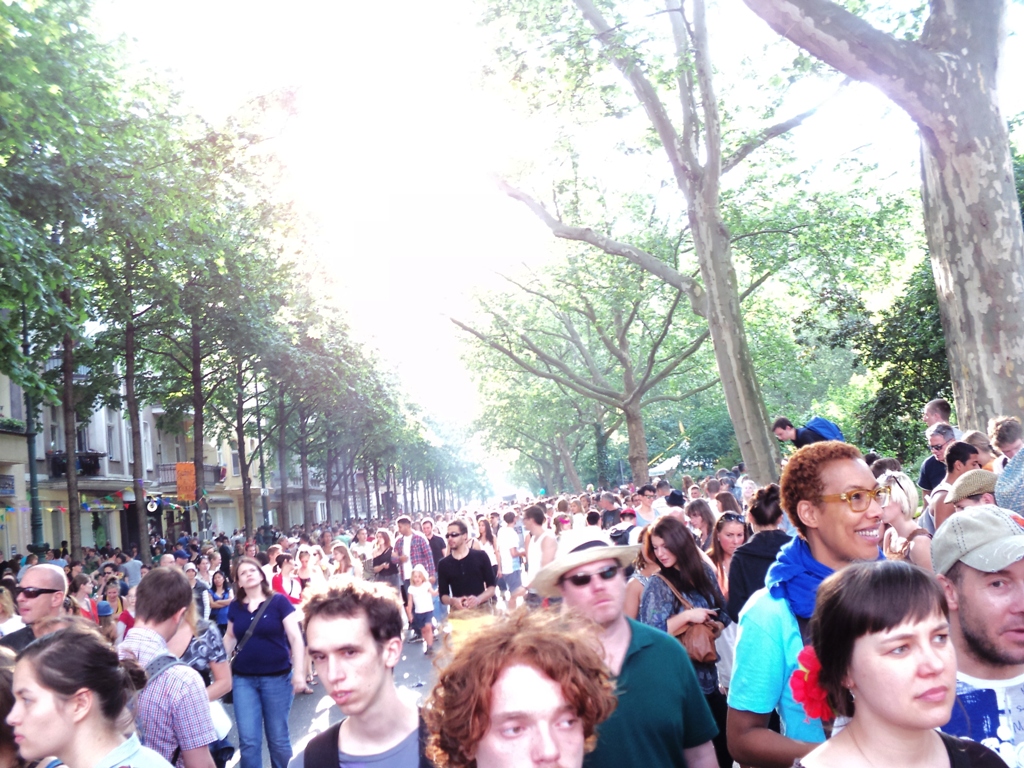
We looked around, and then we saw a deluge of people who were walking, running and eating. He was true; the venue was widening in each second. It was like an oversized train and each group of people became a chain as in such a train in which each compartment becomes its part. We walked forward and followed the people. We knew at least one million people would turn out there on that Sunday. After a stride we stood for having a slice of bread and ya, again walked forward. We looked as if three chicks which walk at a moon-lit night. We could not know what exactly happening there and we were wondering that it was the much celebrated carnival of culture! After walking at least 3 KM, we reached a place where lakhs of people gathered massively and we saw countless counters of eateries. The first one at the extreme corner of the road was a Tamil restaurant run by Sri Lankans, we just waved our hands. There were hotels and stalls of each countries and they served very diverge tastes. From that time, the crowd was getting increased in each moment, the place suddenly suffocated with the excess of the throng. We thought we would miss each other in the crowd.

Suddenly we noticed in the nearby street road, five-six police vehicles were moving bit by bit. We were afraid of something bad which was about to happen. We crossed the road and expecting that ‘something’. When reached there we felt the street was already parted very nicely into a beautiful path and from afar a saffron coloured flag was seen. We read it No. 1 and at a snail's pace, it was coming out from the western side of the street. We made our camera ready to catch the moment. A relentless and continues music was approaching towards us. When it was about to reach at us, we knew it was not one, a flood of parades were coming there. The sounds of the different music rested above. Yes, the riot of colours here started! 

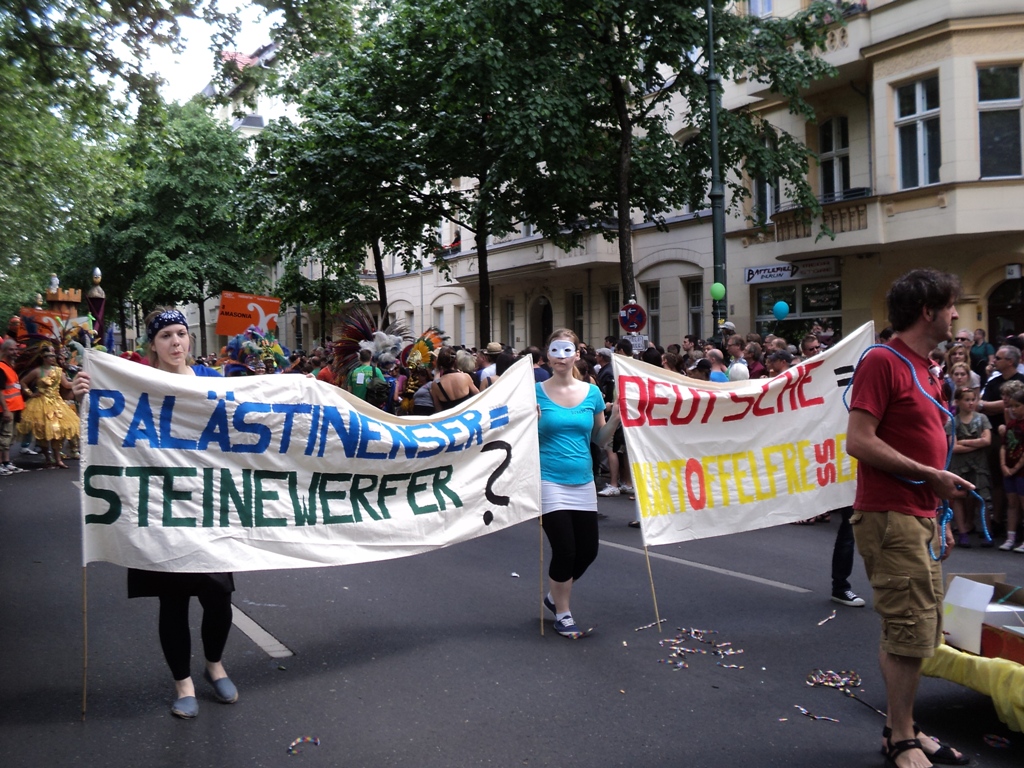
The great parades of Carnival of Cultures have just begun. People lined up with their innovative ideas and dresses. Some people came there with wonderful and strange dress, some with a minimal dress and some with full covered dress. We saw Palestine people with a placard declaring their solidarity to the Berlin Festival. Children from different parts dressed up beautifully and sang fantastically, and then they were seemed as fresh angels flied down to the earth. Some played tricks also. Small kids mixed their hands with chocolate and shook hand to people only to make others hands dirty! A funny chocolate shake hand! When Vivek saw a kid offered a hand, he shook his to get a fistful of chocolate colour! He could not understand what was happening and the lady near to him very politely offered a tissue paper to clean it. Yes, it was the time to celebrate, dance, make fun and also such a simple help.

On the Sunday of 27th May 2012, about 4.800 participants machinated in 90 groups changed Kreuzberg District of Germany into a riot of colours and ideas.
Every summer, Berlin celebrates its own unique carnival, called the Carnival of Cultures - more than 1,5 million visitors flock to the district of Kreuzberg to celebrate the multicultural spirit of Germany’s capital. The procession started at 12.30 pm, at Hermannplatz and ended approximately 9.30 pm, Yorckstraße.
The street procession focuses on the cultural richness of Berlin, and also highlights the often hidden treasures of its international cultural scene. It questions everyday life and politics. Carnival is a combined art form that embraces many aspects of artistic expression. Due to the global migration currents it is multifaceted and of mixed styles. 

The Carnival of Cultures is open to everybody and all forms of cultural expression. It is regarded as a platform for a proud expression of hybrid cultural identities, containing traditional and contemporary elements. It includes and attracts all age groups, professional artists and amateurs, people from all walks of life. People from all over the world come to Berlin to take a look at the colorful costumes and cheerful performances. The carnival of Cultures is one of the main events in Berlin which is taking place every year through the streets of the city between May 25th and May 28th in 2012, with a four-day street-festival, the Parade (28th of May) and various parties throughout the whole city.

The colorful highlight of the festivities is the street parade, where more than 4,500 performers in authentic costumes, elaborately decorated floats, and musicians from over 70 different countries dance through the streets of Berlin. 
Soak up the samba rhythms, enjoy Brazilian drummers, Congolese singers, Korean culture groups, artistic larger than life puppets - and a bit of Rio de Janeiro in the streets of the German capital.
The idea of a carnival which presents the cultural and ethnic diversity of Berlin was developed in 1995, i.e. at a time when – as a consequence to the political and economic changes since the fall of the Berlin Wall and the unification of the two German states – a lot of social, economic and cultural changes happened. Due to these changes, to the economic decline of Berlin and the different economic levels and social and cultural experiences of people in East and West Berlin, social conflicts became more evident and even increased. This state of change resulted, among other things, in a biased and prejudiced view on immigration, which was reflected in the public discussion.

At the same period of time, Berlin attracted a growing number of artists from all over the world and a new cultural off-scene developed, which added to the cultural richness of Berlin. Berlin developed into one of Europe's music centres with a focus on different styles of electronically generated music.
There had been attempts to initiate a carnival in Berlin in the past. Those concepts which had been based on already existing patterns, like the carnival in Rio or the Notting Hill Carnival in London, did not gain sufficient support and could not be implemented in Berlin.

The involvment in carnival activities strengthens the bonds within ethnic communities and among all the groups alike. Their presence in the national and international media lead to a growing self-esteem within ethnic communities. Therefore, the Carnival of Cultures promotes the awareness for the positive impact made by immigrants on Berlin's cultural and social life. Large numbers of young people are involved in carnival activities, many of them coming from multi-ethnic or difficult social and economic backgrounds. While participating in the preparation for the carnival, many of them develop a level of commitment and reliability most unusual in their daily life. Many bands from Berlin's wide-ranging live and electronic music scene as well as theatre and art groups add their aesthetic visions to this sensual and joyful celebration.

Berlins Carnival has been inspired by modern European carnivals like the Notting Hill Carnival in London and the Rotterdam Zomercarnaval. It has taken in elements of many traditional carnivals and celebrations from all over the world. By being open to cultural rites, customs and traditions it attracts performers from countries without carnival traditions. The inclusion of all these elements makes the Carnival of Cultures in Berlin quite unique.
By inviting numerous associations, institutions and individuals in Berlin – among them theatres and arts schools, youth and community clubs and ethnic associations, individual artists, musicians, bands and DJs – the WdK built a network of carnival activists which was and still is the basis for the Carnival of Cultures.

From the beginning on, it encouraged a discussion on the adaption of elements immanent to carnival, including music, dance, masks, theatrical elements, performance and crafts.
The WdK provides the participants with workshop facilities for the preparation of costumes, masks and decorative elements for the floats. By doing so, it offers the groups a chance to meet and discuss their artistic concepts and means of implementation. The artistic quality of the group presentations has been stimulated and increased by the introduction of a competition during the parade in the fourth carnival year, 1999. Prizes are awarded to the best carnival groups, floats and youth groups thereby encouraging the development of all aspects of carnival.


We were watching each country and each and every country dressed up magnanimously, China came with a giant dragon, Japan appeared with a wonderful melody playing, all most all European countries came with an adorning festivity. We three waiting for India, we were sure, India would come if not now but definitely by late. For example if you visit the East Side Gallery painted in the (in)famous Berlin wall,  the last painting  is the Indian flag with a description of Amma Amirt, Budha nirvana, Muhammed light.... an Indian painter portrayed the glory of India in a very artistic manner. What I am saying here is India is near to the heart of the people of Berlin. So we waited and waited. When we felt hungry we went to a Turkish Kebab shop and ordered falaphel but with opening our one eye to see Indian parade.

Then we heard a Bengali song and a group of Bengali babus. We thought it would be India, but they were the exact Bengalis, I mean the people from Bangladesh. They stepped with the dance they were playing. People were expressing their ideas in a very attractive manner. We saw the protest against the non-vegetarian culture by the proponents of the vegetarian culture with a huge pig shedding tear. We saw the German parade who were shouting against the privatization and chanted for swedeshi brand. After a pause, there came Nepal with a very impressive theme. In the front of the rally, people dressed up like the three important religious priest. A Hindu sanyasi, a Muslim moulana and Christian achan and the people same dressed in the same manner followed them. It upheld the harmonious character for their country. They shared words in Hindi.

Parades came and went, we saw a lot of countries flags except India, but when it seemed the parade was ended, the next rally started. We were optimistic and walked towards the origin of the parade and thought when Indian parade started we could also participate in it. It was near about 9 O’clock at night. When we were about to reach the venue we saw a mixing of light in the sky and deafening sounds, and thousands of followers started to line up in a parade at the starting point. It was the African beauty. People were mesmerized with the charm of African wild music as a flout man’s pipe and followed them. It was amazing. We stood still and waited again for India. And the last parade came again a Latin American parade. Even the last man followed it. 

That moment we realized India would not make its usual last appearance. We were desperate. Far away we saw some ladies with ‘Indian sarees. They must have also expected an Indian flag in this all cultures event. We approached them and within moment made a new plan. Immediately we drew an Indian flag and upheld it and walked forward as we were representing India.
Saare jahaam se se achaa
Hindusthan Hamaaraa..
Sang we loudly.


Monday, August 6, 2012

An Incredible Journey of a Mother to the heart of India (Calicut-hyderabd-delhi-shimla-delhi-hyderabad-bangaloor-mysoor-wayanad-Calicut), Part 1


This is a simple note about my incredible journey. Incredible journey? Did a 55+ aged mother have an incredible journey? Frankly enough! In my life I have not even journeyed so long, my maximum distance at a sitting was some 100 KM, it may be a stopover to my sister’s house, from Kondotty to Wazhanad or my daughter-in-law’s house, from Kondotty to Palakkad. But one day, a phone from my son, Musaahique gave me enough laughs. He invited me to accompany to him to Delhi! My answer was very important; I could either thankfully refuse that offer or dare to accept it! Despite of all the teething troubles such a long journey would give me, I accepted that proffer. Doing this I had two intentions; firstly I sought to know whether he was serious and also I really wanted to go to somewhere faraway place. Each journey is a starting from our mundane life, no matter whatever its outcome may be, the journey is important. Until he was explaining his journey plan, I was thinking he was jockeying. But he was serious and well determined. The journey plan was very complicated, to me at least. I heard  only a few places in his chart.
-Calicut-hyderabd-delhi-shimla-delhi-hyderabad-bangaloor-mysoor-wayanad-Calicut-

Firstly, I re-figured this map into -kondotty-areacode-manjeri-perintthanlamanna-manjeri-kondotty-. I could only reflect my imagination like a small circle of my village. My India is vast, vaster than I ever thought about. Whenever the news about the journey spread out, all put their fingers on their noses. All were apprehensive about my health. Some advised me to not take risk, and instead suggested me to favour to take the last option, a journey to Mysoor.  North India is another world! a country of far far a way land. Firstly, I also considered taking the last option, but there were also some others who encouraged me to go with my son wherever he goes and some dared to ask him to append Kashmir too to the plan! Each journey gives us an endless experience and when I am concerned even a single step from my house is a starting point where a flood of experience begins to come!
at Hyderabad Central University
My son had obtained a gold medal from two central universities for his study excellence. He was placed first in MA Sociology from IGNOU, New Delhi and PG Dipolma in Dalid and Minority Studies from Jamia Millia Islamia, New Delhi. He missed the gold medal award-giving-function of IGNOU and when it’s time to get a gold medal from Jamia Millia Isalmia he readied to go to receive it. To make this event more colourful and blessed he invited me to accompany him. My family has extended support to go to the far away land. All of sudden, everything happened!  But still there were some practical problems. He was in Hyderabad and somebody wanted to come to take me to Hyderabad. My three sons and daughter- in-law also were in Hyderabad. One day my youngest child phoned me and asked to come with some of his friends to Hyderabad. I agreed.
at Jamia Millia Islamia
I remember that day distinguishly. It was a fine, rainless November day. Flowers were bloomed everywhere. Monsoon has just stopped to make the event merrier, and the water it poured all along was filled even a single hole on the earth. My mind murmured, it is the best time to go anywhere. I started that very unexpected, but thrilling journey to affix new meaning to my life. I stepped into the train from Palakkad. Palm trees waved their leaves to send me off. Train seemed very happy to carry a lucky mother to go far. I was about to daunting with the new atmosphere, but the presence of those students who all were students of Moulana Azad Urdu National University, Hyderabad gave me enough safe feeling in a compressed and packed compartment.  I did not even my seat; the idea of reserved seat was a new thing to me. But they helped me and found a very comfortable seat for me. 
beside Taj Mahal
Train was in a very fast pace. The sound of chuk..chuk of the train resonated my own heart beat. I was separating from my beloved state into an alien, scary land. Instead of feeling fright, I enjoyed the journey. The night I slept in the train with millions of very colourful dreams. In my dream I was alone and was going to a valley where flowers blossomed and birds chirped and from far away a very small girl started dancing. The face of that young gal was not so lucid. She sang a very familiar song I used to sing in my childhood days. After a song, that child came along to me, I was surprised, it was me, and her face was mine! My dream was about me! I enjoyed that song, and when I was awake, the sun was already there. One of the students said to me, in a very low voice that the whole night I was singing some old songs! I said them: ‘Those all songs are not old, it all came from my fresh mind’.
before Jama Masjid
When the train halted the next stop, I heard some strange sounds of another languages, I looked at the sign board. It was Wijayawada. I took my mobile phone; the battery charge was already empty in it. I took a ‘reserved battery’ and inserted a new Andhra SIM card which my son had given me to put in when I cross the boundaries! Now everything is new, and from the freshly charged mobile phone I rang to Hyderabad. After years of struggle for living, first time I was going to a far a place. In a dreamy state, I was about to sleep again in day-time Suhaib came and said: ‘Umma we are reaching to the Secunderabad railway station’ then suddenly I got up and freshed my face with water. The train was on time until that time, but when it was about to reach its destination, it started to go very slowly, slower than a snail. I heard the sigh of the train. It only produced the chuk chuk sounds, but did not want us to leave it. one seat in this train was my abode at least for some hours. Then the train totally stopped. People were complaining and abusing for ‘the dead train’, but I felt rather very sorry to that poor train! Train only makes its name meaningful only there are thousands of travellers, and when nobody is there its only a iron coated machine body. So when it was about to reach its last destination, it did its last option to lag a little more time only to give it to be a meaning being.
Red Fort
When I was reaching there, my sons and daughter-in-law were already present there. They gave me rose flowers. I felt very happy. When I hugged my children I felt home in Hyderabad. We did not have much time before going to Delhi. I stayed with my son that day. I was too tired so I slept when I saw the bed. In a certain moment, I woke up. Still there was the light in the room, I tried to open my eyes and stand to switch off the light, and when I switched off the light, a meek sound came from the corner.
‘Mam, I am still awake. I am searching for a ticket for tomorrow’
‘Searching for a ticket for tomorrow?’
I did not comprehend what my son was saying, then he explained.
‘I booked our ticket for tomorrow, but the ticket from Hyderabad to delhi has been cancelled. I booked it through the website www.irctc.co.in. so if a seat is not confirmed it would be cancelled automatically. So I am trying to find out some other way to get a ticket’
‘Ok, well’
at Lotus Temple with two Swedish tourists
I actually did not understand what he was telling me. So I wished him a solution and returned to finish my broken dream. When I got up next day, he was still before his laptop, I was totally upset with him and in a very slow voice I express my disquiet with him for avoiding his sleep in the night. Then he told me in an excitement.
‘Mom! Finally I found a solution for our journey. I searched all the way around and at last found two trains to go to Delhi. In the first train we will go to Nagpur and we will stay in Nagpur a day and from there we will catch another train to Delhi. Actually there is not a single train to go without a break, and we don’t have another day to post pone our journey’.
He thought I would be very dissatisfied if I heard that very strange idea, but I was very happy to go wherever he would go. For me, this journey was not for a destination, but for travelling all around India. 
Qutub Minar
The next day at 10 am, we reached at the train station. I have never seen such a crowd before in any railway staion. Every inch of Secunderabad railway station mackerel packed with the people. I was scared I might lose myself in that crowd. The train was going to Bihar. Though it was a sleeper class, each seat, two or three ‘illegal’ passengers occupied all most all the ‘reserved’ seats. Our two seats reduced into one. He told me the idea of RAC. One of our seats was occupied by a teenager. We did not say him to leave the seat, he was looking at us and expected anytime he would be asked to get up.  There was also another man, a guy with a moustache and a pot belly, he was sleeping or rather pretending that he was in a deep sleep. He got a middle birth and he was ‘sleeping’ in that seat and made enough hard to the other passengers who were supposed to sit in the lower birth. All the five passengers were compelled to sit the other side. A pot bellied man in one side and five persons including women in the other side! I was thinking India is very divergent is all aspects!
The train started moving. A journey to a wonderland, a mother in a wonderland would be the apt title for this post. Suddenly I felt I lost everything which I thought would help always. My language became just some disturbing syllable to others and only my son understood what I communicated through it, what helplessness! Before me there was small kid with her mother and always it slipped from the seat, my heart ached, but my tongue was tied, no word which familiar to her did not come out it. I, in a very low voice, but 
Hyderabad
sometimes in a bit louder pained her gesture to slip and I said only, ‘mol’, ‘mol’. I tried to believe that in all language words for mother and child must be same. When I failed to lull or convince that small kid, I turned back and held my son’s hand tight as if I were a small kid who confronted difficulties to speak its first syllable to its mother. If we don’t know a language we are equal to a innocent child!

((This is a translated version of a travelogue originally written in Malayalam by Maimoona Rahman))

Friday, August 3, 2012

A Visit to ‘Spy Bridge’, Germany


Suppose when you are alone and unexpectedly a seraph appears before you and she blesses you a boon that whatever you wish, it will turn to be true! What you will then desire? We got an opportunity to visit a ‘wishing well’ where our wish would come true. When we reached the well, there were millions of coins sunk in the well already.
Vivek Singh looking into 'the wishing well'
So if we put some Euros or at least some cents, then the wish will come true in a faster way. Most of the people actually wished (it seemed) to seize all that Euros from the well, oops! What a bad idea! But I wished to not put any coin into the well, surely my wish would not come true. So I stood up aside and watched what my Spanish friend would wish for! She put some Euros and wished ‘let the world ever remains in peace! I don’t think all the Europeans are very superstitions, but this wish anyway was very noble and motivational!
Dear reader, I must not start this note on wishing well, actually I was thinking to put pen to paper a bit about the famed ‘Spy Bridge’ in Berlin. But the moment I thought about the bridge this ‘wishing well’ business came to mind first. Let me make clear what this spy bridge is precisely. In my first blog post (berlin wall) I have elucidated the Berlin Wall and the countless sufferings of the people the wall made possible to them. Glienicker Brucke, popularly known as Spy Bridge articulates the same old story of two oppositional blocks which occupied the beautiful Berlin city. The eastern side of German (including Potsdam) was shared for Red Soviet Russia and the Western part was given to Britain, France and US of America. This is only a part of the story. History of the bridge actually starts a bit early. When the major towns Berlin and Potsdam flourished side by side, this bridge was constructed in 1907 in the Havel River to connect these two cities.
'the Natural Fridge'
It was broken heavily in world war second and later a major reconstruction was carried out to meet people each other. As I just mentioned above, as part of the sharing business the bridge was also shared within the four countries, USSR, USA, UK and France. The offices of spies of both sectors formed surroundings of the bridge. Spies met and made ‘friendly talk’ here. Prisoners and people were exchanged here, and it stood a bare spectator to the cold war. Literally it stood witnessed to the power sharing dealing. You look at closely the bridge; half of the bridge was painted black to declare the power of the mighty countries.
I was thinking about our Hussain Sagar of Hyderabad when I was scrutinizing the bridge. Hussain Sagar divides Secunderabad and Hyderabad and both carry the legacy of colonial past. Seconderabad was actually built to gratify French power and they made it a cantonment to establish their power in Hyderabad. All bridges are the silent witnesses of ugly business everywhere!

The bridge immediately became a symbol of spy dealing and exchanging prisoners. Thousands of poems were written on the bridge. Films, cartoons, TV serious refereed the bridge. Smiley’s People, a novel written by John Le Carre made this bridge famous by continuously referring the bridge. The popular nickname 'Bridge of Spies' was used by the British band T’Pau as the name of the title track on their first album. The usage is metaphorical, referring to a 'walk to freedom' but in the context of long dreamt-of relationship.
After visiting the spy bridge we went to the palace (not exactly to the palace, but the courtyard of Schloss Cecilienhof fortress). It was a very sunny day in a cold shivering winter. 
When the sun mercied upon us to go anywhere we wished without wearing the maddening winter jacket, then we preferred to visit the palace. It was one of the earlier journey with a group called Erasmus Students Network (ESN, Potsdam), an effort of some dynamic young (wo)men to make a get together possible within the foreign students. We are not ERASMUS students, yet we were invited.
Schloss Cecilienhof  has been built in an eye catching place of the northern part of the Neuer Garten park. When we crossed the threshold the courtyard, the birds started chirping, squirrels squeaking, and a gentle breeze slowly passed telling stories to the dancing meadows, tall and short trees agreed unanimously what the breeze brought for them, later the wind ended and merged in the nearby Jungfernsee Lake, and then a school of fish jumped expressing their joy. Flowers smiled, beautiful butterflies flied everywhere!
Between 1914 and 1917, Kaiser Wilhelm II had Schloss Cecilienhof built in the north of the gardens for his son Wilhelm and his wife Cecilie. The use of traditional building materials such as brick and wood helps the house to blend in with its surroundings.
the red flower star was the contribution of Soviet Russia
The actual size of Schloss Cecilienhof only becomes evident upon closer inspection: the house has a total of 176 rooms. Some of them were used by the Allies in 1945 for their Potsdam Conference. Its design was based on a house called 'Biston Court' (later 'Hillbark') on the Wirral Peninsula which in turn was inspired by Little Moreton Hall. The interior was furnished according to plans by  Paul Troost, who originally had designed steamship décors.
The brick and oak timber frame building, including six courtyards and 55 carved brick chimney tops, should have been completed in 1915, but construction was delayed due to the outbreak of  World War I and Crown Prince Wilhelm and Cecilie could not move in until August 1917. 
Wilhelm followed his father into exile one year later, while Cecilie stayed at the palace until she fled from the approaching Red Army in February 1945. ! It was part of soviet Russia, so they made a beautiful Courtyard with red flower star, planted by Soviet armed forces in 1945.
There is a ‘natural fridge’ as well! When the shivering and bone chilling cold comes, the lake starts freezing completely. So the royal family made from this natural phenomenon  useful and built a pyramid shaped fridge where the icy lake water stored in the pyramid and they kept food items until the winter ends.
When we started the journey the weather was perfect and fine, but later the climate gradually changed and it became cold again.

Monday, July 30, 2012

Book Review: The McDonaldization of Society


"Little boxes on the hillside,
little boxes made of ticky-tacky,
little boxes, little boxes, little boxes
little boxes all the same"
- Malvia Reynold


Until I devoured George Ritzer’s book The MacDonaldization of society, I was thinking everything is very normal in our society, but now I realized we all are enchanted by the process called McDonaldization. Otherwise you tell me, whenever you get in to a McDonald’s or any fast-food restaurant, have you ever (I never) surmised why the guys in work are ‘acting’ very buzy, why in the shop only a few seats to sit but why more tables, why not any newspaper but only a TV above? Why not there is any kitchen inside and why they show their messy kitchen out? Why only a few menu and limited choice to offer? Why always young and energetic chaps are appointed there and why not old or middle aged? Why always the workers are replaced with others and why they have a uniform? And most often the employee asks us whether you eat it here or should he packs? Why the burger or any fast-food shows quantity rather quality? Or at least why the workers are wishing us ‘it’s my pleasure to help you or have a nice day?
To me, these questions were very stupid until I thumped through George Ritzer. Everything is beyond our expectations and our calculations, the book says.
George Ritzer is an American sociologist and he published this book in 1983 when nobody, even in India, envisioned about our today’s 20-20 cricket. He has not mentioned the term cricket anywhere in the book. Definitely he is not a Malayalee, and he does not know our Malayala Manorama and there is a least chance he visited in Hyderabad. But surely he has hinted at least three things, 20-20 cricket and Malayala Manorama and Hyderabad Tour Packages!
You read these paragraphs I quoted from his book,
"In the past few decades, the leadership of collegiate and professional (cricket) decided that fans raised in the McDonald’s era wanted to see faster games and many more (runs). In other words from (Cricket) what they got from their fast food restaurant- great speed and large quantities. It was believed, apparently correctly, that faster and higher scoring games would mean greater attendance and higher profits.  Instead of the often the defender taking his turn at his bat, someone whose main (and sometimes only) skill is hitting replaces him. Designated hitters will get more hits, hit more runs, and help produce more runs that defender who are allowed to bat. (quote continues...)"
"Stories in (Malayala Manorama) usually do not jump from one page to another; they start and finish on the same page. To meet this need, long, complex stories often have to be reduced to a few paragraphs. Much of a stories context, and much of what the principles have to say, is severely cut back or omitted entirely. With its emphasis on light news and graphics, the main function of the newspaper seems to be entertainment". 
Thousands of words are emerged prefixing McDonald’s or at least two simple letters ‘Mc’. McDentists, McDoctors, McChild, McStables, McPaper, McSex are some of these words.
So this term seems nothing to do with our eating habit. He explains in the book
"This is not a book about McDonald’s, or even the fast-food business, although both will be discussed frequently throughout these pages. Rather, MacDonald’s serves here as the major example, the ‘paradigm’ of a wide ranging process I call McDonaldization, that is
The process by which the principle of the fast food restaurant are coming to dominate more and more sectors of American society as well as of the rest of the world".
Why McDonald? Four alluring dimensions lie at the heart of the success of this model and more generally, of McDonaldization. McDonald’s has succeeded because it offers consumers, workers, and managers efficiency, calculability, predictability and control.
It offers the best available method to get from being hungry to being full. Calculability or an emphasis on the quantities aspects of products sold. Quantity has become equivalent to quality; a lot of something, or the quick delivery of it, means it must be good. As a culture, we tend to believe deeply that in general ‘bigger is better’. Predictability: the assurance that their product and services will be the same over time and in all locales. The people who eat in fast-food restaurants are controlled, albeit subtly. Lines, limited menus, few options, and uncomfortable seats all lead diners to do what managers wishes to do- eat quickly and leave.
After this point Ritzer goes far and compares all most all our social institution and checks how all these are McDonaldized. His extreme comparison of McDonald’s with Holocaust is worthwhile which seems he has such a strong disgust against the system called McDonald’s. McDonaldization and Holocaust show the same process, effectiveness, calculability, predictability, controlling and irrationality of rationality. The holocaust is an ‘efficient’ means for the destruction of massive numbers of human beings and it’s quite calculable that how many people could be killed in the shortest period of time (calculability) was effort to make mass murder predictable. Victims were controlled by a huge non human technology including the camps, the train system, the crematoria, and the bureaucracy that managed the entire process. He uses Weberian concept of bureaucracy and he shows if we examine the beurocrartization and McDonazation both share the same things. If we extend the McDonazation methods we can apply this theory to Shopping malls, entertainment, health care system, education and even pregnancy and death.
For instance when we hear Americans are hardly doing abortion, don’t think it a very positive thing rather they have already made everything possible to avoid the ‘abortion’, such as the selection of preferred gender, semen for a healthy and non diseased child, keeping a tentative pregnancy, doing all medical check up to see the ‘product’ called child in a ‘factory’ called hospital. Even death today becomes very McDonaldized, you can now compare all the leading point of McDonaldability of death also. Death becomes a rather entertaining business. Read this adv.
‘You will now have a choice! Louiseville’s affordable funarel home is your best choice; professional services $995; metal caskets as low as $160; opening May 1, 1994’

After all McDonaldization is nothing but the Americanization of society in a bad way.
This letter to the boss of McDonalds from a very passionate consumer when the main shop was in a verge of closing down: ‘Please don’t teare it down! Your company’s name a household word, not only in the United states of America, but all over the world. TO destroy this major artefact of contemporary culture would, indeed, destroy part of the faith the people of the world have in your company. (ER. Ship).
Like many of our scholars, Ritzer does not end up the book without any creative suggestion, but from the very first page he is telling how to lead a unMcDonaldized life today, in the concluding chapter he puts forwards a number of practical solution to escape from the McDonaldization, but the million dollar question is whether we learn a half lesion from it?

Sunday, July 22, 2012

First Flight Journey (Part 1)


Most of you guys might raise your eye brow when you read this post. True, the same feeling I also will have if I read a bit of penning about ‘my first bus journey, or ya at least ‘my first train journey’. Flight now is not an unusual thing. Today in facebook, I saw people were hashing out MA Yusaf Ali’s resignation from the post of Air India Board in repudiating the step motherly attitude of Air India to its travelers, I felt that most of my buddies from Gulf countries partook that news in their wall, that’s obvious. So this post is not for you, dears, but some others who still can’t deem that a machine called aeroplane carries people and goods through the air. They only have a mind of what they think about an aeroplane. In my childhood, the picture of an  aeroplane  was always fixed with a line of a mappila song my mother always sang. Its UK Abu Sahla’s song, I still only can recollect those two lines,

Vaanil parakkum vimaanamedukkuka
Athu kannakalum thorum cheruthaakum

(oops! Blur memory yaar! I skipped a line!, anyone memorize that line?)
Its translation is almost ‘take the example of an aeroplane which float through the air
It becomes smaller when our eyes are far away!
So my image about the aeroplane in those days was something which grew to be smaller and smaller when it went to the colourful sky. We in our toddler days really envisaged only a rocket could make the white marks, so we were wondering these rockets were coming every day, or three, four in a single day! But later we were aware of that those were not the marks of paths of rockets, but any flying object could make those marks.

I still remember my first train journey, from Calicut to Ernakulam. Train, always resemblances a huge maggot! Yup! In the film MIB (I), the very first scene is placed in a railway station where a small worm suddenly grows up bigger and bigger and takes the railway track to dart smoothly. What an imagination, I appreciate it. Both train and maggot have so many similarities. The railway station was mackerel packed with a huge crowd. The train was approaching. I had taken a general ticket, but I did not really know which compartment I must get in. When I enquired to my co-travellers, they replied but a snigger. Train came and I jumped into any of an 'S' bogie. To my luck, TTR did not catch me, so I escaped from the jail or at least a penalty.

Forgive me! I realize that I have much diverted from the topic. I was telling this all only to say, that when you read this, don’t feel, ‘ ho! This guy did not get any other topic to talk about or prrr! This boring sort of flight experience I heard so many time, and I heard about the Anna Hazare drama less than this!’
When I saw the airport first? It was on 25th April 2012and when I saw the airport, all my beautiful imaginations about an airport has just broken down, or at least shattered! I felt it was nothing but just a Secunderabad railway station (I must not say it looks like Secunderabad bus station, because it’s quite big!). I had to fly to Germany and my plain was at 9.15, so I must report at airport at least three hours before the departure.

Those days it was very hot! Sweat dropped out from every part of my body, especially from fore-head, if it were in red colour you must believe that  blood was oozing out! I got up very early from my bed only to wake up to an imaginary world where I would have flight, air, cloud and air hostess as my company. My classmate was also with me and she had already flied home by air. So I thought nothing was to be wired.

The previous day, I had called my uncle, Salam Kodiyathur.
‘Hi! Uncle! I am calling you this busy time only to clarify one doubt.’
‘Ok, what is that serious doubt?’
‘What must I do whenever I am given the panji and water by airhostess?’
Panji and water? What do you mean? It sounds like absurd.
I explained what I saw in a Malayalam film, Vettom in which Dilip was foxing the heroine.
Uncle burst into a laugher and after five or seven seconds, he explained that it is just another joke from Dilip, nothing serious in it.

We booked a taxi to fetch us to the airport. Taxi was very luxurious and when the driver turned A/C and a Tolliwood film song, the luxury started to augment. My brother Punnodi was with me, he was actually in an ecstasy. He always talked to the driver in a broken Telugu. When the comfortable cold inside began to diffuse slowly into my mind, I, bit by bit, went to a snooze. Driver was rushing to the spot, but whenever he crossed maximum speed limit the car stopped with a shriek and it got me also up.

The Rajive Gandhi airport in Hyderabad is very spacious. A kind of fright slowly erupted from my toe and it suddenly reached to my brain, that moment I felt to go to toilet. I said my brother to go back only when he got my missed call. We entered inside the airport. I smiled when our frog caged in a well, came to my mind, and I was thinking whether that frog and me had any similarity. Only 20 KG were allowed in our baggage. When my luggage was given, I saw it just crossed 20. If the lady at the counter (Is she also an air-hostess?) had asked me any additional charge for extra weight, I would have preferred to throw away two KG of washing powder, I soliloquized.

I already mentioned that I felt the airport as just an extended railway station, all the announcements resemblanced it. The destinations are same, Delhi, Vishakapatanam, Chnnai, Cochin, Kozhikode, Coimbathur, Ambala... I felt very hungry and it was the time of breakfast. I had time till my flight expected to arrive. I went in search of some food. When I heard the prize of a single kattan chaya, my belly murmured me, ‘daay! I am ready to put hold your hungry till you are provided a vegetarian ‘Hindu meal’ in the Air India. I felt very pleased to my suffering stomach! After a long waiting a sugary voice got nearer through the announcement box:
Flight number 2324 from Hyderabad to Delhi has just arrived and passengers are requested to board on. I queued to feel my first plain journey.